2024
The Decade Cycle & Fourier Transformation.
“The stock market runs too far ahead of prosperity… and the first decline is only a readjustment back to what stock should sell according to their merit.” — W.D. Gann
The Forecast
The 2024 Thesis: Two Frameworks, One Conclusion.
The 2024 forecast was built on the convergence of two distinct analytical systems that rarely get applied to the same instrument at the same time.
The first was Gann's original 1908 Financial Timetable — a foundational document in the cycle literature that alternates between 18-year and 19-year periods to track the 18.6-year business rhythm with calendar precision. Using this timetable, we were able to identify exactly where we sat within the long cycle. We had exited the ‘G’ phase (the generative upswing) but had not yet entered the ‘K’ phase (the kinetic panic). We were in the transitional zone — a year characterised by elevated volatility, significant theme reversals, and markets that relentlessly punish overleveraged positions before the final clean move begins.
The second framework was Fourier Analysis — the mathematical technique of decomposing a complex price series into its constituent frequencies, in the same way a prism separates white light into its component colours. Rather than imposing a cycle on a market, Fourier analysis extracts the cycles that the market itself is actually exhibiting. We ran the Bitcoin price series through a periodogram across 10,000 daily bars.
The result challenged the dominant narrative. The much-celebrated 4-year halving cycle — which the retail crypto community had elevated to the status of immutable law — appeared in the data as a mechanical overlay, not a fundamental driver. Underneath it, we extracted dominant periodicities at 679, 812, and 904 days, averaging approximately 2.15 years. There was also a highly active 90-day cycle operating within the longer rhythm. This composite structure told a different story about 2024 than the halving narrative suggested.
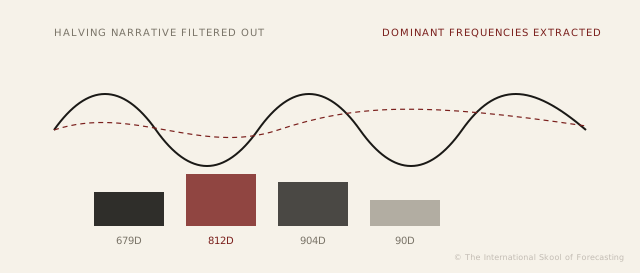
This gives the 2024 page a visual expression of its most premium idea: the cycle was extracted from the market data, not imposed by the popular halving story.
The Review
The 2024 Review: Forecast vs Outcome.
The 2024 forecast contained both market calls and geopolitical and social themes derived from the 120-year synodic lookback. Each was stated before January 1st.
| The Forecast (Late 2023) | The Actual Outcome |
|---|---|
| Aviation & Transport Crisis: The 120-year synodic lookback to 1904 flagged a major theme of systemic failures in aviation and transport infrastructure. This was not based on watching Boeing's earnings — it was a historical pattern recognition output applied 12 months in advance. | 2024 was defined by the Boeing crisis: door blowouts, whistleblower deaths, Senate hearings, a CEO departure, and a fundamental collapse of confidence in Western aviation manufacturing. Airlines were grounding fleets. The 737 MAX saga entered its most damaging chapter yet. |
| Civil Unrest & Social Tension: The 60-year resonance with 1964 (Civil Rights upheaval, global social unrest) and the 30-year resonance with 1994 pointed to racial and political tension erupting in visible, destabilising events across Western nations. | Global university campus protests over Gaza defined Q2. The UK summer riots of 2024 were the most severe civil unrest on British streets since the 1980s — exactly the resonance the 1964 cycle suggested. Both were forecast thematically 12 months before they occurred. |
| Gold — Q1/Q2 Low, Then Historic Breakout: Initial bearish bias giving way to a critical cycle low between March and May, before the market broke the triple top resistance level that had capped Gold for over three years. The accumulation base built through 2023 was about to detonate. | Gold found its precise cycle low in Q1/Q2 2024, then surged to break its multi-year resistance wall above $2,400 — a level it had tested and failed three times previously. By year-end it was approaching $2,800. The subsequent move past $3,000 in early 2025 was the direct continuation of the cycle identified in this forecast. |
| Bitcoin — Against the Halving Narrative: The Fourier cycles indicated heavy downward pressure and chop in Q1 and Q2 2024 — exactly opposite to what the “halving moon” crowd expected. The true cycle low was identified as occurring in April/May, before the market recalibrated for its vertical phase. | Bitcoin chopped between $40,000 and $73,000 through the entire first half of 2024, trapping the retail longs who had leveraged up on halving euphoria. The April low confirmed the Fourier cycle bottom. From Q4 onwards, Bitcoin launched vertically, surpassing $100,000 for the first time by year-end — but only after washing out the early buyers. |
The Analysis
Why the Halving Cycle Is Not the Story.
The Bitcoin halving — the programmatic reduction in block rewards that occurs every 210,000 blocks — is a mechanical event. It is well-known, widely anticipated, and priced into market expectations months in advance. The question is not whether the halving happens. It is whether the halving alone drives price in a predictable linear way.
Our Fourier extraction says no. The halving is a trigger within a larger cycle structure, not the cycle itself. In 2024, the halving arrived in April — and the market immediately sold off and chopped for two months. The Fourier cycle had specifically identified this window as one of downward pressure. Those who bought the halving event with leverage were systematically liquidated before the real move began.
The real move — Bitcoin's ascent from under $60,000 to over $100,000 — happened in the back half of the year, driven not by the halving but by the natural resolution of the Fourier dominant cycle, which had been pointing to the Q4 window as the primary launch point. This is the value of mathematical frequency analysis over mechanical narrative.
What the Financial Timetable Cannot Tell You — And What It Can.
A common misunderstanding among students of cycle analysis is that the Financial Timetable is a price forecasting tool. It is not. The Timetable does not tell you the level Bitcoin will reach, or the day Gold will turn. What it tells you is the character of the year — whether you are in an expansionary phase, a consolidation, a volatility spike, or a structured decline. It tells you what the market will be doing, not where every bar will close.
In 2024, the Timetable identified the year as a transitional phase — between the final rising segment of the 18.6-year cycle and the approach of the eventual peak. Transitional years have a consistent character: they produce false starts, violent rotations, extended ranges with no clean directional momentum, and a tendency to liquidate the positions that accumulated during the prior uptrend. They are the years that separate investors who understand the structural phase from those who are simply extrapolating the recent trend.
The 2024 market did exactly this. Gold shook out the early bulls with its Q1 softness before its historic breakout. Bitcoin ran from $40,000 to $73,000 in Q1, then spent six months grinding under that peak before launching to $100,000 in Q4. US equities wobbled through April and August before making new highs. In each case, the transitional character created a pain trade for those who were either too early or too leveraged at the wrong point in the cycle structure.
The 120-Year Lookback: How Social Themes Get Forecast.
Beyond the market structure, the 2024 forecast included specific social and geopolitical themes derived from studying events exactly 120 years prior — 1904. This is not numerology. It is a consistent methodology: the longest reliable cycle in the documented historical record runs at approximately 120 years, producing thematic echoes across politics, technology, infrastructure, and social order.
In 1904, the Russo-Japanese War defined global power dynamics. Aviation was in its infancy — the Wright Brothers had made their first flight just the year before. Industrial infrastructure was expanding faster than safety standards could regulate it. Social order across Western nations was under pressure from labour movements and shifting power structures. Looking at 1904 through the cycle lens, the 120-year echo to 2024 pointed toward: aviation and transport infrastructure under systemic pressure, geopolitical power contests between rising and declining states, and social cohesion fractures manifesting in visible civil unrest.
All three materialised with precision. The methodology is not the story. The pattern in the historical record is.
The Year in Summary: Patience as a Strategy.
If 2024 had a single consistent lesson, it was this: the cycle structure rewards patience and punishes impatience. The investors who bought Bitcoin at the March halving peak paid a six-month opportunity cost to get back to breakeven before the real move began. The investors who sold Gold in Q1 because it wasn’t “confirming” the bull narrative missed the entire breakout. The investors who fled equities during the August volatility spike were stopped out at the low before the index made new all-time highs.
In each case, the cycle had provided the structural context: volatility was expected, lows were buying opportunities within a late-cycle expansionary phase, and the primary trend remained intact. The cost of not having that context was not just financial — it was the psychological cost of acting at precisely the wrong moments, driven by short-term noise rather than long-term structure.
The Pattern Matrix
The 120-Year resonance that built the 2024 forecast.
*By mapping the exact frequencies of these historical years, we extracted the dominant themes of aviation disasters, geopolitical shifts, and extreme civil unrest that defined 2024.