Most market analysts treat weather as noise. It rains, a cold front stalls over the grain belt, drought arrives — and the analyst notes it, files it, then returns to the chart. Weather is external. Temporary. By the logic of most modern approaches, it is not really part of the method at all.
Gann disagreed. Not from sentiment, and not from a farmer’s instinct for the land. He disagreed because he understood a specific mechanical truth: an agricultural economy is a leveraged system. The crop is the collateral. The season is the primary risk factor. When the season turns hostile, the leverage does not affect one market — it propagates. Grain. Feed. Livestock. Transport. Storage. Insurance. Financing. A single difficult year can express itself across a dozen commodity chains simultaneously, and it does so with a lag structure that creates predictable windows of supply stress and price pressure.
That is why weather appears in the Gann research archive. Not as scenery. Not as local colour. As a structural input — one that, when combined with the broader cycle analysis, helps the analyst understand whether a given year is likely to be generous or tight before the season has confirmed itself in price.
The planetary year system.
At the foundation of this method sits a classification of calendar years by ruling planetary character. Seven planets. A repeating sequence. Against a table extending back into the nineteenth century, a researcher can place any year within the cycle — and with that placement comes a set of historical tendencies: the kind of spring that opens the season, the moisture character of the summer, the typical quality of the harvest, the severity and timing of the winter.
The cycle is not astrological in the popular sense. It is closer to what we would now call a periodicity framework: the observation that different year-types recur with enough structural regularity to be worth classifying and comparing. The planetary names are the labels. The content is empirical — accumulated meteorological observation, sorted by year-type, and extended forward as a working prior.
The first thing to understand about this system is that its value is sequential rather than singular. Any individual year’s ruling character is less important than where that year sits within a longer run of years. Some planetary characters tend to generate supply abundance — years that relieve inventory tension and ease commodity financing. Others carry supply risk that is moderate and sector-specific. And some generate the kind of systemic, broad-based shortage that moves across crop chains, feed markets, transport, and fuel simultaneously. The experienced analyst is not just reading the character of the current year. They are reading the sequence.
The second thing to understand is that planetary character is a background condition, not a forecast. It does not override the primary cycle work. It sits beneath it — a starting hypothesis that raises or lowers the probability of stress or ease in commodity markets. When the seasonal character of a year aligns with a known turning window in the longer cycle analysis, the case for close market attention is strongest. When it diverges from the cycle picture, the analyst notes the divergence and watches for resolution rather than forcing the interpretation.
Gann used weather this way: as one layer inside a multi-layered reading, where the convergence of independent signals was the meaningful event — not any single layer in isolation.
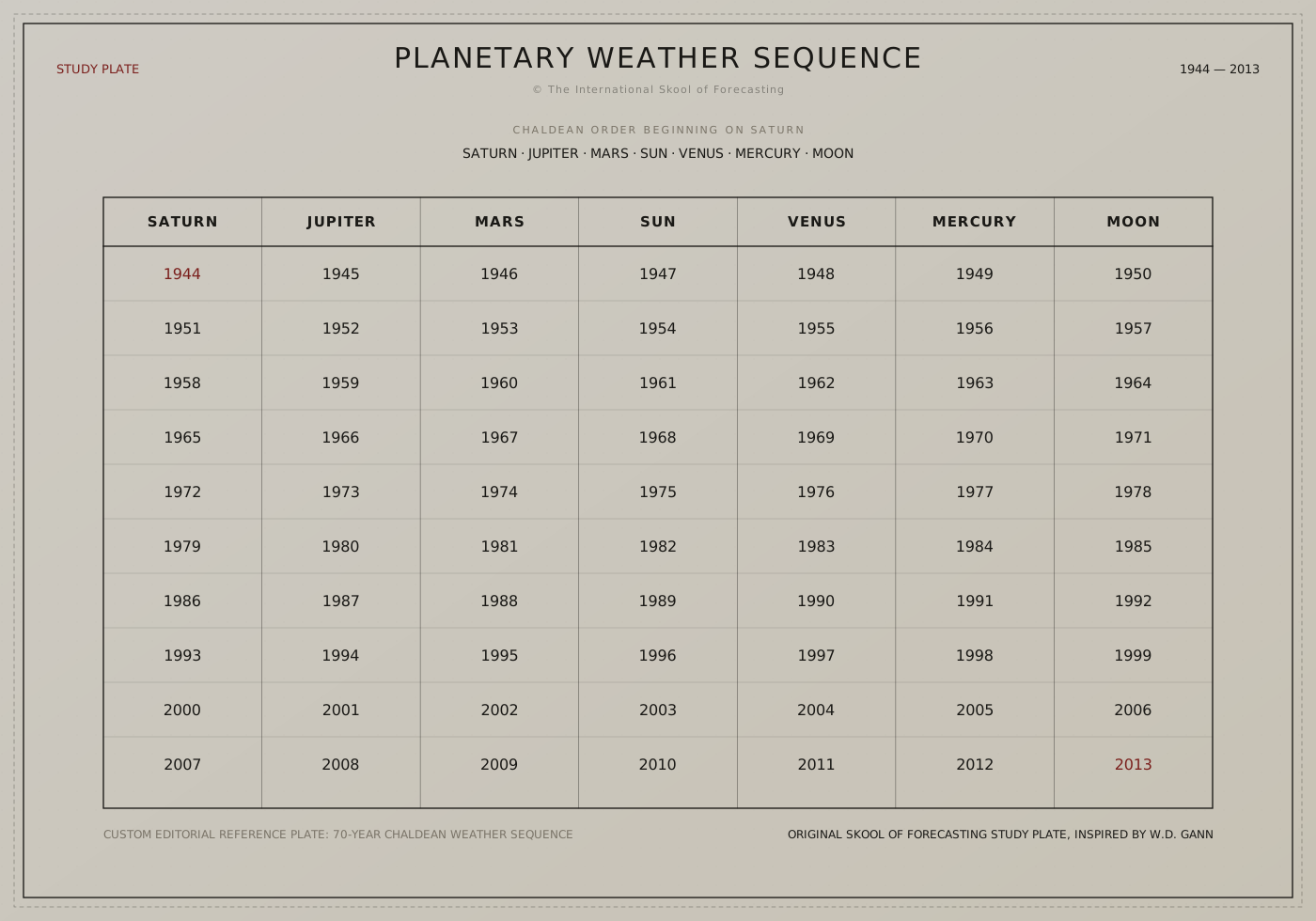
A custom Skool of Forecasting table built for this essay: the Chaldean sequence restaged as a cleaner 70-year study plate, beginning on Saturn in 1944 and running forward through the full sequence.
The seasonal archive as a reference class.
Beyond the character profiles, the archive contains something more specific: a catalogue of historically extreme years, sorted by type. The severest winters. The mildest. The driest summers. The wettest. The warmest and coldest by year. These are not predictions in the prophetic sense — they are the output of a classification exercise applied to observed historical data, then extended forward using the periodic structure of the cycle.
Gann’s own framing for this is worth noting: these forecasts, he writes, are based on meteorological observation across many years. They are not guesses. They are calculations grounded in what has been — and in the observed regularity with which such conditions recur. That is a precise epistemological claim: not determinism, but structured probability.
For the commodity analyst, an archive of this kind functions as a reference class. It answers the question: in years of this type, what typically became scarce? What arrived late to market? Where did the financing strain accumulate? That is a different question from “what will happen?” It is the more useful question: given the seasonal character of this year, which commodity chains deserve the closest attention?
The archive does not replace observation. It precedes it. The analyst who enters a new year with a well-developed prior — this is a cold-and-wet year-type, historically associated with early transport disruption and tight fuel — is asking better questions earlier than the analyst who waits for the evidence to announce itself in price.
Seven characters, seven supply profiles.
The planetary classification is most useful when understood as a set of distinct supply-risk environments, each with a recognisable market character. Not all difficult years are difficult in the same way. The experienced analyst distinguishes between them.
Some year-types carry their stress in the spring — cold, late starts that compress the planting window and raise early-season crop uncertainty. Others are generous in spring but punishing in summer, where heat or excess moisture destroys what the opening months had promised. Some turn difficult at harvest, when the timing window closes before the crop is safely in. And some present the real problem in winter, when tight supply meets heavy demand for the first time and price discovery happens under duress.
Among the seven characters, certain ones carry the heaviest broad-based supply burden. The cold-and-wet year-types are the most consistent in their market signature: they stress multiple commodity chains simultaneously — grain, fruit, livestock, and fuel — rather than creating sectoral pressure that the wider market can absorb. When cold suppresses both the crop and the transportation network that moves it, shortage compounds rather than disperses.
The hot-and-dry year-types operate differently. The stress is concentrated and intense rather than diffuse. Specific crops — those most dependent on consistent moisture at critical growth stages — take the damage. Others thrive in the heat. The market picture is therefore one of divergence: some commodity chains tighten sharply while others remain well-supplied. That divergence is itself an analytical signal.
The wet-summer year-types present a specific and underappreciated risk: quality failure rather than quantity failure. A standing crop that receives too much moisture at the wrong point in its development does not simply produce less. It produces damaged output — grain that will not store cleanly, hay that rots in the windrow, fruit that fails on its way to market. Quality-driven scarcity is harder to read from supply data alone. It tends to show up first in basis spreads, then in elevator discounts, then in end-user rejection — a slower-moving but ultimately comparable market stress.
And then there is the year-type that is deceptive in a different way: the season that appears generous, where the harvest comes in well and supply looks ample — but which sets up a sequence of harder years to follow. The analyst who reads only the current year misses the positional significance. Some of the most important market intelligence in the planetary cycle is not what is happening now. It is what now is setting up for the years ahead.
These distinctions cannot be fully mapped in a public library article. The depth is in the course material — in the historical year-by-year record, the crop-chain overlays, and the archive of extremes that makes the classification system operational rather than theoretical. What this page offers is the framework: the understanding that planetary year character is a supply-risk typology, not a weather forecast, and that each type has a distinct market signature worth learning.
Two years from the record.
Abstract frameworks are easy to accept and easy to dismiss. Historical years are harder to argue with.
1816. In the planetary cycle, 1816 falls under a character associated with cold, dry springs — difficult openings, wet and damaging summers, early autumn frosts, and a year that is broadly described in the archive as sterile: poor across most crop chains simultaneously rather than stressful in one sector and generous in another. The actual historical record of 1816 is one of the most documented agricultural catastrophes in the northern hemisphere. Mount Tambora had erupted the previous year, loading the atmosphere with enough particulate to suppress global temperatures noticeably. Across New England, frosts occurred in June, July, and August. Grain crops froze in the field. In Europe, the harvest failed across a wide band of latitude. Livestock starved. Grain prices in parts of England more than doubled between spring and autumn. Famine conditions spread through Ireland, Wales, and large sections of Germany and France. The year is remembered as the Year Without a Summer — but the commodity market history is what makes it analytically legible. The stress was not local. It was systemic, simultaneous, and it propagated through supply chains in precisely the sequence the framework predicts: crop failure → feed scarcity → livestock losses → grain hoarding → transport pressure → price spikes across multiple markets at once. The planetary character for that year-type reads as a sterile year. The historical record of 1816 is a case study in what a sterile year actually looks like when it arrives.
1846. The planetary cycle places 1846 under the cold-and-wet character — the year-type associated with poor, late springs; cool, wet summers with abundant and sometimes violent storms; early autumn frosts that cut the growing season short; early freezing of rivers and transport routes; and a specific advisory about food and fuel: both will be scarce, demand will be heavy, and the time to build inventory is before the season unfolds. In Ireland, 1846 was the second consecutive year of potato blight — but it was the first year in which the crop failed completely rather than partially. The summer of 1846 was cold and wet. The harvest that autumn was a catastrophe: diseased, rotted, and largely absent from the fields. Food prices across the British Isles spiked. Relief infrastructure collapsed under the volume of need. Fuel became scarce simultaneously as the winter deepened early. The year 1846 is not remembered as a market event — it is remembered as the beginning of the worst phase of the Great Famine. But strip away the political history and the human tragedy, and what you have underneath is a cold-and-wet year-type delivering exactly the supply outcomes that its planetary character predicts: broad-based scarcity across food and fuel, compressed harvest windows, early transport disruption, and a financing crisis that extended well into the following season.
These are not cherry-picked coincidences. They are the kind of alignment that becomes visible when you hold the planetary year classification against the historical commodity and agricultural record systematically. Some years confirm the character precisely. Others partially. Occasionally the alignment fails. The point is not perfection. The point is that the framework is specific enough to be tested — and that when you test it against documented history, it holds up with enough regularity to be worth using as a research prior.
How a season becomes a market.
The mechanism that connects seasonal character to commodity price is not immediate, and understanding the lag structure is what separates this research from almanac-reading.
When a season stresses a crop, the market effect unfolds in stages. The earliest signal is in crop condition reports and acreage surveys — the forward-looking supply intelligence that influences futures pricing months before harvest. The second stage is the harvest itself: actual yield data, quality assessments, and the grade composition of what goes into storage. The third stage is the basis — the spread between futures and local cash prices, which reflects the specific supply-demand balance in each production region. The fourth is transport: the freight markets, rail logistics, and river barge rates that move the crop from farm to consumer. The fifth is the downstream industries: the feed mills, flour mills, and processing facilities whose input costs rise when the crop is tight or degraded.
And then — often six to twelve months after the harvest — comes the financing stage. Poor crop years create payment stress on the farm, on the elevator, and on the input supplier. That stress affects the credit conditions for the following season’s planting. Which affects the following season’s supply. Which closes the loop back to the beginning of the cycle.
This lag structure is where the early research value lies. The analyst who identifies the seasonal character in the first quarter of the year — before the crop is in the ground, let alone in the bin — has a meaningful temporal advantage over one who waits for the market to reflect the supply stress. The signal is available early. The confirmation arrives later. The gap between those two points is where preparedness becomes a market edge.
Weather is not an external variable that occasionally intrudes on commodity markets. In an agricultural economy — and the world remains, at its base, an agricultural economy — the season is the background condition from which supply stress originates. Treating it as noise is a choice to be surprised by something that was, in structural terms, readable in advance.
Calculation, not prophecy.
Gann was careful about his own framing here. The seasonal forecast work, he noted, is grounded in meteorological observation accumulated over many years. The numerous successes of past forecasts, he argued, justified extending the method forward. That is not the language of mysticism. It is the language of empirical pattern recognition.
What he was describing is structurally similar to what modern climate scientists call analogue forecasting: identifying historical years with similar atmospheric and cyclical signatures, and using them to construct probability ranges for the season ahead. The claim is not that history repeats mechanically. It is that it repeats structurally — with enough regularity to provide useful priors, and with enough variation to require ongoing observation.
That distinction matters for how the method should be used. The planetary character of a year is a starting hypothesis. It is not a script. The analyst who enters a cold-and-wet year-type with that prior in mind then watches whether the season is actually confirming the character: Is the spring opening later than normal? Is summer moisture elevated? Are harvest timelines compressing? Is livestock health deteriorating? The prior sharpens the observation. The observation updates the prior. The interaction between the two is the research.
How to work with it.
The starting point is simple: identify the ruling planet for the current calendar year. The table in Gann’s archive assigns a planet to every year from 1800 onward on a repeating seven-year sequence. That assignment is mechanical — there is no ambiguity about which year belongs to which character. The research begins after that assignment is made.
With the year-type established, the analyst holds two questions simultaneously. First: is the season confirming the character profile? Watch the opening quarter for spring conditions that match or diverge from the historical type. Watch the summer moisture balance. Watch the harvest timing and quality reports as they emerge from the production regions. Watch the winter develop. At each stage, the analyst is asking whether the prior is being validated or revised by live evidence.
Second: where does this year sit in the sequence? Some year-types are more significant for what they are setting up than for what they are delivering in the current season. An analyst who treats each year as independent — evaluating only the present season against the present price — misses the sequential logic that gives the system its real depth.
The commodity chains to watch will vary by year-type, but the analytical habit is constant: translate the seasonal character into a supply-risk hypothesis, then position your market observation around that hypothesis. Grains if moisture is the dominant variable. Livestock if disease or feed availability is stressed. Fuel if cold is the expected pressure. Transport if timing is the constraint. The seasonal prior does not tell you where prices will go. It tells you which markets are carrying elevated structural risk — and that is the more durable analytical input.
For the complete year-by-year table and the full character profiles for all seven planetary types — including the specific crop, disease, and supply-chain tendencies associated with each — the course material is where this research lives. This library article is the framework. The depth is in the study.
One layer, not the whole picture.
Weather cycles will not make a trader out of a spectator. No single layer of the Gann method will. What this layer does is provide one more dimension of structure: a way of entering each year with an informed hypothesis about whether the background conditions favour commodity stability or stress — and which type of stress is most probable.
That is a modest claim, and a correct one. It belongs alongside the time cycle work, the historical price patterns, the planetary positions, and the long-wave structural frameworks that define the Gann research tradition. It is not a shortcut. It is not a mechanical predictor. It is a research discipline — a way of asking better questions at the beginning of the year so that the answers, when they arrive in price, are less of a surprise.
The library exists to restore this kind of thinking to working practice. Most of it has been set aside — quietly discarded in favour of indicators that react to price rather than anticipate condition. The consequence is that analysts repeatedly find themselves surprised by commodity stress that, viewed through the seasonal archive, had a legible prior history and a recognisable shape.
Weather is part of that history. Once you understand how it connects to the larger cycle picture, it is difficult to unsee.