Library
Wheels Within Wheels — the hierarchy of market cycles.
A cycle never exists in isolation. It is always a gear turning inside a larger gear, which is itself turning inside a master clock.
The term “Wheels Within Wheels” describes the basic architecture of cycle work: smaller timing wheels turn inside larger ones, and the larger cycle bends the smaller one around its own rhythm. A short cycle can look convincing in isolation and still fail when the bigger wheel is turning against it.
That is why serious cycle analysis begins with context. Before a student asks, “When is the turn?”, the better question is: which wheel is in command?
A cycle is a window, not a date.
A market cycle is a recurring rhythm that appears with enough consistency to be useful, but not with mechanical precision. It behaves more like a season than a train timetable. Spring does not arrive at the same hour every year, yet the season is real, measurable, and forecastable within a band of time.
This is where many students misread cycle work. They expect a high or low on an exact date. When the market turns early, late, or in stages, they decide the cycle failed. The better approach is to work with an orb: the allowable timing range around a cycle’s expected completion. An 18-week primary cycle, for example, may express itself inside a wider 15-to-21-week window and still be behaving normally.
This is not cycle mysticism. It is a disciplined way to read markets as overlapping time structures: long waves for backdrop, intermediate cycles for swing work, and short cycles for entry and exit.
- Identify the dominant cycle before trusting a smaller one.
- Use orbs and time windows, not exact turn dates.
- Watch translation to judge whether the background tide is rising or falling.
- Look for confluence when several timing wheels line up at once.
The Hierarchy of Timing.
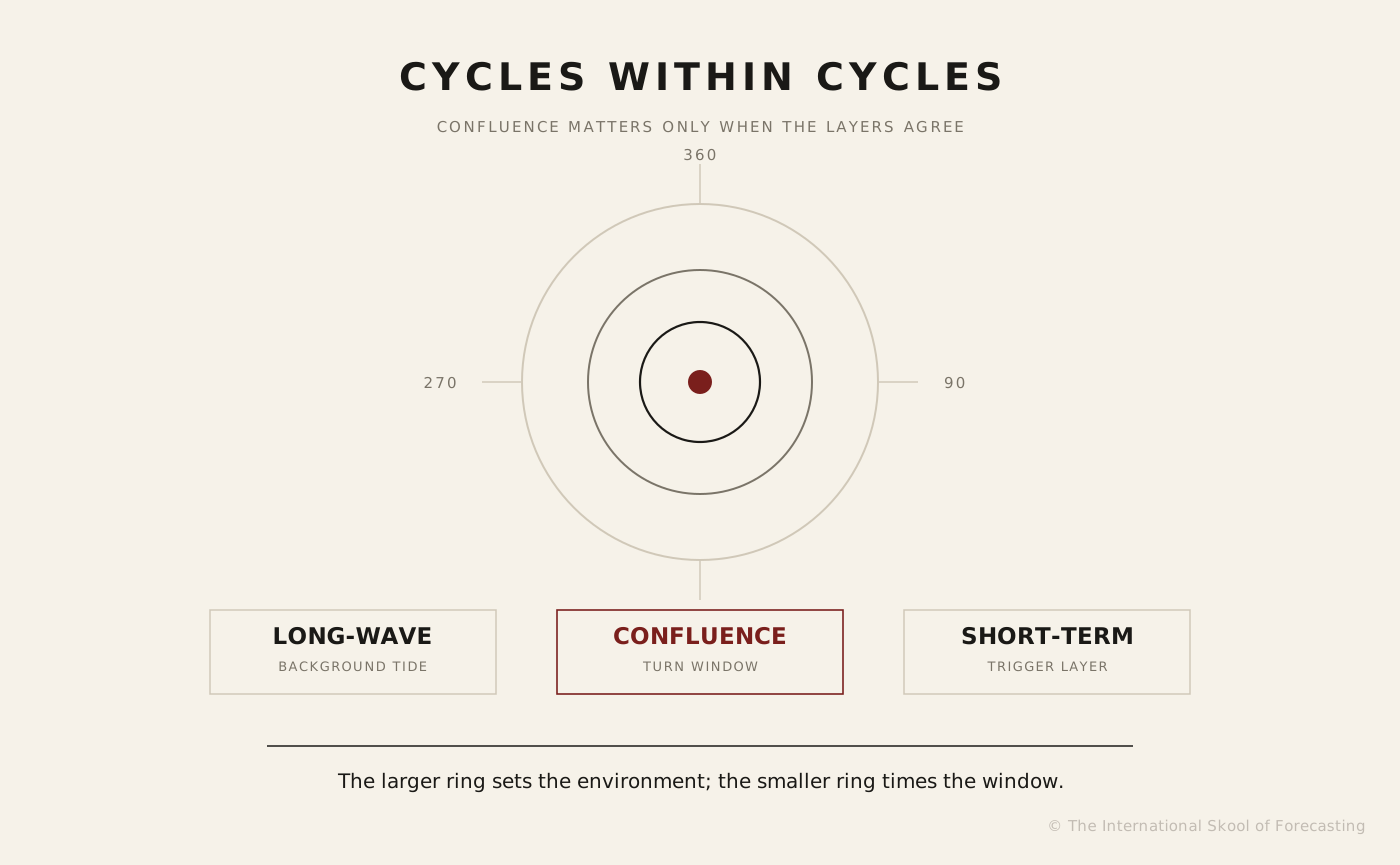
The forecasting framework organises the market into three layers of cycle activity. The larger layer sets the backdrop. The intermediate layer gives the working rhythm. The smaller layer helps time the turn.
- Long-Wave Cycles: The 20-year, 18.6-year, and 54-year Kondratiev waves. These define the “Era” and the general direction of inflation, interest rates, and generational sentiment.
- Intermediate Cycles: Rhythms lasting months rather than years. For example, the 33.5-week cycle in Bitcoin or the 18-week primary cycle in the S&P 500. These are the “workhorses” of the swing trader.
- Short-Term Cycles: Daily and weekly rhythms driven by lunar phases, solar degrees, and short-term liquidity shocks. These provide the precise “entry” and “exit” triggers.
Right and Left Translation.
Translation explains why a cycle peak does not always arrive in the middle of the cycle. When the larger wheel is rising, smaller cycles often translate right, meaning they peak late in their own rhythm. When the larger wheel is falling, smaller cycles often translate left and peak early. Translation is one of the cleanest ways to see whether the background tide is helping or resisting the smaller move.
The Power of Confluence.
Forecasting is not the search for a perfect cycle; it is the search for Confluence. Confluence occurs when the troughs or peaks of multiple wheels gather around the same time window. This is what Merriman calls a “Primary Turning Point.” When the larger wave and the smaller rhythms agree, the resulting move is far more meaningful than any one cycle alone.
Why one count is never enough.
Most weak cycle work begins with a single attractive count. A trader finds a rhythm that fits the past, extends it forward, and calls the next date important. Sometimes that works by accident. More often, the market turns early, late, or not at all because the trader has ignored the larger wheel.
The better question is not, “Does this market have a cycle?” Almost every liquid market has recurring rhythm somewhere in its history. The better question is, “Which rhythm is dominant now, and is the smaller cycle translating with it or against it?” That question changes the entire quality of the work.
A student who only counts days is still outside the method. A student who can judge cycle age, orb, translation, and confluence is beginning to read the market as a living timing structure.
The course shows these ideas across real markets: U.S. stock indices often cluster around 18-week, 50-week, 18-year, and 36-year windows; gold tends to respect 18-week and 50-week rhythms; currencies and commodities each carry their own recurring bands.
The point is not a magic number. The point is learning the family of numbers and how they line up.
This page gives the language: hierarchy, orbs, translation, and confluence. It does not publish the private workflow for selecting a dominant rhythm, rejecting weak counts, building a timing window, or reviewing the window after the market speaks.
That practical work belongs inside Wheels Within Wheels.
Where to continue.
If this essay made the market feel less random, that is the beginning of the work. The full program teaches the practical process: how to test candidate rhythms, decide which wheel is in command, work with orbs, read translation, and build a timing window that can be reviewed honestly.
Study Wheels Within Wheels next. The public essay gives the map; the course shows the chart work, examples, tools, database, and review discipline that turn the idea into a usable forecasting process.
Understanding the hierarchy of cycles is one step inside a larger method. For the multi-decade structural frame that positions these individual nested cycles inside generational commodity cycles, continue into The 36-Year Cycle: Saturn in Aries. For the foundational principles underlying how Gann read time, read W.D. Gann — Time, Price and What He Actually Meant. To work with the complete cycle composites and wheel-within-wheel forecasting, that material is available inside the course library.
Explore Wheels Within Wheels