Library
How to read a mass-pressure chart.
The chart is not a signal machine. It is a timing map: a way of seeing where pressure is building, easing, or becoming ready for a change.
Most traders look at a chart and see price. They look at where the market was yesterday to guess where it might be tomorrow. This is like looking at footprints in the sand to guess where the ocean is going. We do not do that. We follow a different rule: Time is the cause, and Price is the effect. A mass-pressure chart is not a map of price. it is a map of time. It shows you the tide of the market before it even arrives.
The core idea is simple: history repeats itself. W.D. Gann taught that if you know which past years to look at, you can see the shape of the future. This is not magic or a "system" you buy in a box. It is a study of the Law of Periodicity. Financial markets follow cycles, just like the seasons follow the sun. When you take the most important cycles and put them together, you get a "Mass Pressure" map. This map shows you when the market is likely to meet resistance and when it is likely to find a tailwind. This is the foundation of market forecasting.
How the map is built.
The bold curve on the chart is a composite line. The common approach — used by most people who study Gann — is to select a set of past years based on fixed cycle intervals and average their data together. The cycles most often referenced are the 10, 20, 30, 40, 60, and 80-year periods. You copy the historical data from those years, average the daily percentage changes, and the composite line is the result. It is a reasonable starting point, and it can produce useful maps.
But this is where most analysts stop. And it is where the accuracy problems begin.
Not all cycles are active at the same time. Some are dominant — exerting real pressure on the market right now. Others are dormant — present in the data but contributing very little to the current structure. If you average a dormant cycle in with three active ones, you are adding noise to your map. You are diluting the signal. The composite line will still look like a forecast, but its turning windows will be fuzzy and its confidence will be lower than it should be.
At The International Skool of Forecasting, the maps are built differently. Before a single cycle year is selected, the first step is to determine which cycles are currently active. This involves understanding where we are in the Lunar Cycle, the Decade Cycle, and the Century Cycle — three overlapping structures that determine which historical years are genuinely relevant to the present and which are not. Only once those cycles are known do we build the composite. The result is a much tighter map with turning windows that carry real conviction.
This is why our forecasts look different from others in the field. It is not a matter of working harder or having better software. It is a matter of knowing which years to listen to and which years to set aside. You can see the output of this method every month inside The Forecaster.
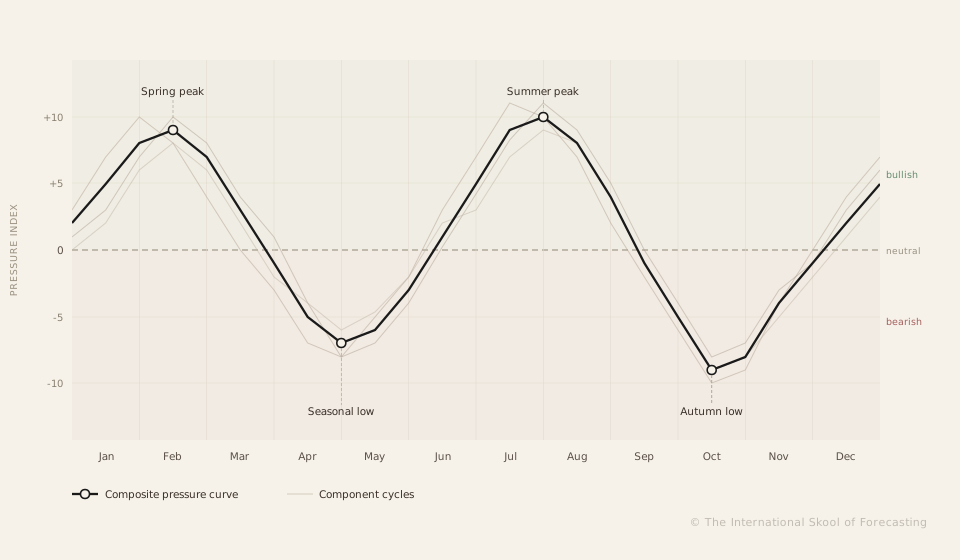 The bold line is the composite. The thinner paths are the component cycles. The circles mark the points where the historical agreement reaches a local extreme.
Pressure vs. Price.
One of the hardest things for a new trader to learn is to stop looking for a price target. A mass-pressure chart will not tell you if the market will go to $100 or $200. It tells you when the market is ready to move. This is why we call it a pressure map.
The side of the chart shows a Pressure Index. When the line is above zero, it means the average of the past years was bullish. When it is below zero, the average was bearish. The further the line is from zero, the more the past years agree with each other. The most important part of the map is the zero line itself. When the pressure crosses from positive to negative, the environment of the market is shifting — often before price has moved at all. A trader who only watches price might see a breakout happening. A Forecaster sees the pressure crossing the zero line and already knows what that breakout is moving into.
The logic of the window.
We do not look for a specific day or hour. We look for a Turning Window. The open circles on our charts identify a two-week window where a turn is most likely to happen. Why two weeks? Because time is not a single point; it is a wave. In this work, we look for clustering.
Clustering happens when many different cycles—like the 10-year and the 60-year—all reach a high or a low at the same time. When they cluster together, the composite line shows a sharp peak. This is a high-confidence turn. It means history is in agreement. If the cycles are spread out over many weeks, the peak will be rounded or messy. A professional Forecaster ignores the messy parts of the map and waits for the clusters. This is where the highest probability of a turn exists. You are waiting for the moment when all the clocks of history strike the same hour.
A two-week window is a useful starting point, but it is still a window. The next step is to narrow it to a day. That is where Time by Solar Degrees comes in. As the Sun moves through the zodiac at roughly one degree per day, it crosses over price and time points that have proven historically significant for that market. When the Solar Degree aligns with a cluster turning window, you have both the larger cycle and the date working together. The window gives you the zone. The Solar Degree gives you the date inside it. This is one of the core tools taught in the forecasting curriculum and the reason turning point calls can be specific rather than approximate.
The Signal of Refusal.
What happens when the market does not follow the map? This is where many people give up on forecasting, but it is actually where the real profit is found. If the map shows a strong bearish pressure for October, but the market stays flat or moves up, we call that a Refusal.
A refusal is a gift. It tells you that the current market is so strong that it is pushing right through the weight of history. Imagine a boat moving at full speed against a gale-force wind. That boat has immense power. If the market refuses to fall when the "Time" says it should, you are looking at a market that is ready for a massive move in the opposite direction. The map hasn't failed you; it has done its job. It has shown you that the current market is stronger than the last 100 years of history. That is information you can trade with absolute confidence. You are no longer guessing; you are reading the strength of the tide.
When the map flips.
Sometimes a market follows the shape of the map but moves in the opposite direction. We call this Inversion. If the map shows a bottom, the market makes a top. If the map shows a rally, the market falls.
W.D. Gann acknowledged this. Inversion happens when a larger, hidden cycle takes over. To the amateur, the chart is "wrong." To the Forecaster, the chart is still right—it is just inverted. You watch the price action during the first turning window of the year. If the market moves opposite to the map, you note it. The timing of the turns usually stays the same, even when the direction is flipped. You follow the map's timing, but you flip your bias. This clinical detachment is what separates a professional from a gambler. You aren't married to the direction; you are married to the time.
The 1929 proof of concept.
Ferrera's research provides the clearest test case for this method. To build a Mass Pressure forecast for 1929, he combined three sets of historical data: the years 1849, 1869, and 1909. These were the years that shared the right cyclical relationship to 1929. When he averaged them into a single composite, the chart showed three things clearly: a significant low in late March, a final top at the end of August, and a panicky break in the fall of the year.
This is what actually happened. The market made a low in late March 1929. The famous high came on September 3rd, just after the August window. And the panicky break — the 1929 crash — followed in October and November. The composite did not match every swing. Ferrera is clear about that. But it showed the shape of the year before the year began. That is the point. The method is not trying to predict every day. It is trying to give you the architecture of what is coming so you know when to be alert.
Ferrera also notes that Gann used a similar composite for his own 1929 forecast, drawing on the years 1869, 1909, and 1919 — all connected to the 60 and 20-year cycles. Both forecasts reached the same conclusion through slightly different cycle selections. That convergence is significant. When different analysts using the same method arrive at the same shape, the map has real information in it.
Each turning point sends ripples forward.
Ferrera describes cycle mechanics with a useful image: think of throwing a stone into a pond. Each major turning point in the market starts a ripple effect that moves forward in time. The more significant the turning point, the larger the ripples. A small turn creates a small ripple. A major crash or a generational bull market top creates a wave that you can still feel 60 years later.
This is why the cycle years are not chosen at random. A Forecaster works forward from major tops and bottoms. The 1932 low, the 1929 top, the 1907 panic — these are not just history. They are the source points of ongoing ripples. When two or three of those ripples reach the current year at the same time, the composite shows a peak or a trough. When they arrive spread across several weeks, the composite goes flat. The flat sections are not noise. They are periods where one ripple is going up and another is going down and they are cancelling each other out. You wait. You watch. And when they converge again, you are ready.
The Forecaster's Discipline.
Reading a mass-pressure chart takes a specific kind of discipline. You learn to trust the map, but you never ignore the price. The map tells you what the weight of history suggests should happen. The price tells you what is actually happening right now. Both matter. Neither one alone is enough.
A Forecaster builds a working hypothesis of the year before the year starts. They know that in April they should be watching for a low. They know that in July there is a cluster of turning windows to respect. When the market reaches those windows, they look to the price for confirmation. If it agrees, they act with conviction. If it refuses, they read the refusal. They are not surprised by the market because they have already mapped the terrain.
Where to go from here.
This article gives you the reading habit. You now know what the zero line means, how turning windows work, what a refusal looks like, and why a flat composite is not an empty space. That is a solid foundation.
What it does not give you is the construction. How you determine which cycles are currently active, how you sequence the composite from those cycles, and how you read the map against the live structure of the market — that is the full course of study. It is not a shortcut. It is a proper training in the original methods, taught in the order they were meant to be learned.
If you want to see the method applied to the current year, the monthly research inside The Forecaster is the place to start. If you want to learn the full construction from the ground up, that is the work of Wheels Within Wheels.
The full method of building and calibrating Mass-Pressure maps is taught inside our advanced programs. If you want to move beyond the public map and master the architecture of time, this is where you begin.
To Go Further
Mass pressure charts are one tool inside a larger method. For the multi-decade structural frame that positions these pressure points inside generational commodity cycles, continue into The 36-Year Cycle: Saturn in Aries. For the foundational principles underlying how Gann read time, read W.D. Gann — Time, Price and What He Actually Meant. To learn how to construct your own mass pressure composites, that material is available inside the course library.
Explore Wheels Within Wheels