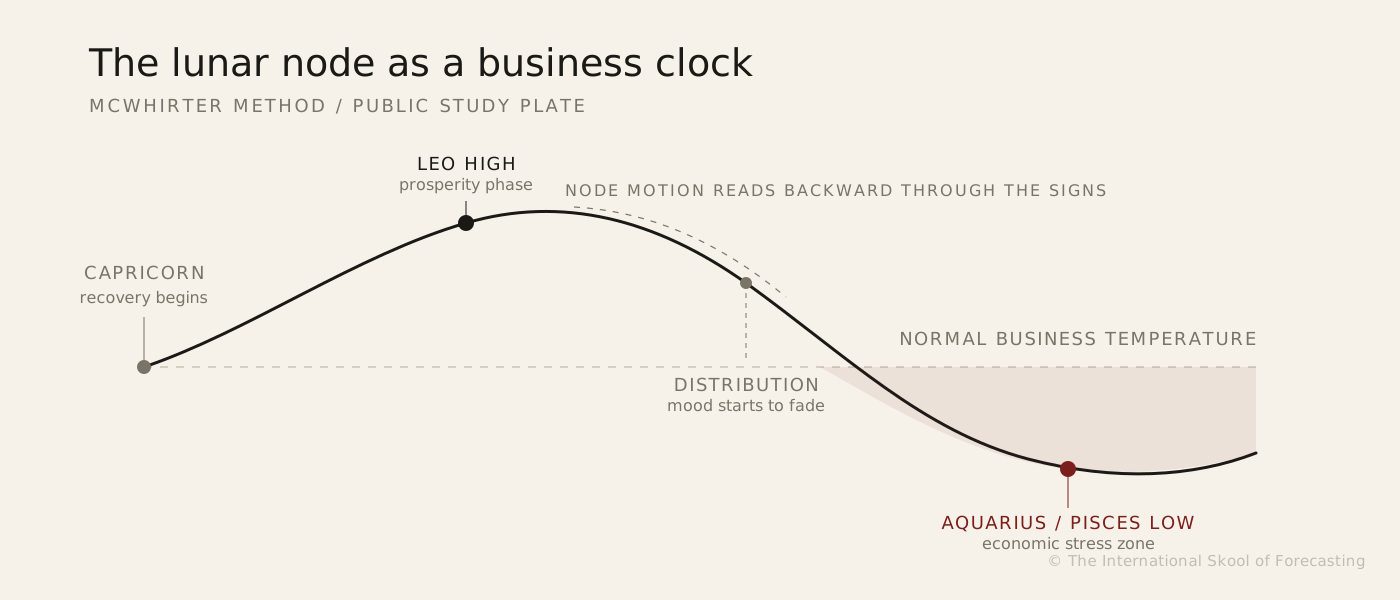
Most traders wait for price to confirm that conditions have changed. McWhirter studied the lunar rhythm behind the business cycle, the monthly market tone, and the pressure building before the chart admits it.
A forecast can know the broad cycle and still fail because it cannot read the month. McWhirter gives the missing pressure layer: when optimism, caution, panic, or recovery is more likely to dominate.
This is the bridge between long-cycle position and practical monthly forecasting.
Includes the Gann Financial Timetable course free. Strict no-refund policy. NDA and identity verification required on enrollment. Enrollment capped at 150 students globally.
This program is also included as part of The Market Forecaster (AUD $6,997), the complete program.
From the desk of Jonathan Evans — — 16 minutes
In the 1930s, the best economic minds in the country admitted something uncomfortable. Business cycles exist — booms happen, busts happen, they repeat. But no one could predict them. No reliable method existed. No usable time factor had been named.
Louise McWhirter refused to accept this. She spent years studying astronomy, business history, and market data. And she found what economics had declared impossible: the North Node — the Moon's intersection with the Earth's orbital plane — moves through the zodiac in a cycle of exactly 18.6 years. When she mapped this against business data going back decades, the correlation was consistent enough to name. She published her findings in 1937. The book is still used because it still works.
The McWhirter Method answers one question before the month begins: the most probable directional bias of the market for the next thirty days. It answers that question using a mechanical calculation based on the lunar cycle — the New Moon chart for the New York Stock Exchange, overlaid with the position of the North Node and the state of what McWhirter called the Secondary Factors.
When the Secondary Factors run bullish, the market has a measurable tendency to rise through the month. When they run bearish, it tends to fall. The signal is not a guarantee — McWhirter herself documented the polarity-flip phenomenon, where the market inverts from the forecast. But the statistical tendency is strong enough to provide a meaningful directional edge before the first trading day of the month. A reactive trader asks what the chart did today. A McWhirter student asks what kind of month the market has entered. That question gives price a context most chart readers have never considered.
This is not a course you browse passively. The video lessons are built in a deliberate sequence because McWhirter's method only makes sense when you work from the large to the small. Each section builds on the previous one. If you try to jump straight to the monthly chart without understanding the long business cycle first, the monthly work loses its context entirely.
The course begins with the long cycle — the 18.6-year North Node rhythm that McWhirter built her entire method on. This is the generational rhythm that rises through Leo (maximum business volume), passes through Taurus (the warning zone), and descends toward Aquarius (the depression low). Before the student attempts a monthly forecast, they need to know where the economy sits in this long tide. A monthly bullish reading in a rising cycle phase is a different thing than the same reading near a long-cycle low. You build a five-year macro outlook in this section and learn to read the secondary factors — Saturn, Uranus, Jupiter — that modify the baseline.
From there the course moves into the monthly method: the NYSE natal chart, born May 17, 1792, its sensitive degrees and angles, and the process of overlaying each New Moon chart to produce the directional bias for the coming twenty-eight days. This is where the work becomes practical. The student learns to state the forecast before the month opens, watch how price confirms or rejects it, and review the result honestly. The course includes assignments that require a working monthly forecast before the student moves forward.
The third section extends the method to individual stocks. Companies have incorporation dates, and when transiting planets cross those natal positions the stock tends to respond. Jupiter transits open buying windows. Saturn transits call for caution. Students build charts for the stocks they follow, identify the relevant windows, and time entries using the same logic as the monthly NYSE reading. Commodities are also covered here.
The course closes with David Williams' solar ingress method and running totals, which add a monthly climate layer to McWhirter's lunar work. Williams gives the student a more procedural way to think through forecasting — what the broader atmospheric conditions say before examining the monthly reading. The two methods work together cleanly, and the final section shows how to bring them into a single annual working practice.
A weak teacher pretends the method always works. McWhirter did not. She acknowledged inversions and polarity flips, where the market expresses the expected pressure in the opposite direction. Inside the program, students learn how to treat a monthly forecast as a probability environment rather than a command. The discipline is to watch how price responds to the pressure: whether the forecast is confirming, whether the market is resisting, and whether a flip is becoming likely. That is what makes the method practical rather than dogmatic.
Students receive the McWhirter Rulebook, onboarding material, workbooks, checklists, quizzes, practical assignments, monthly worksheet material, and access to software tools built to reduce the calculation burden. The Gann Financial Timetable course is included as a foundation. The tools are not substitutes for understanding. The point is to teach the method first, then use the tools to accelerate the work. The gatekeeper structure is specifically designed to prevent tools from becoming black boxes.
The right student is already competent with charts. What they are missing is the timing layer: a disciplined way to form a directional hypothesis before the market moves, rather than explaining each move after the fact. A student from ICT, SMC, Wyckoff, Gann, or ordinary technical analysis can use this work as a directional filter: take long setups when the Secondary Factors are bullish, treat the same setups with suspicion when they are bearish. That is a more mature use of timing than trying to force any method into a signal service.
This is not for someone who wants astrology language without market work. It is not for someone who needs a blind signal. The method requires observation, review, and the willingness to learn from inversions. If that process sounds like serious study rather than frustration, this is the right program.
Our proprietary Secondary Factors indicator shows extreme bearish readings building throughout 2007 — forecasting the conditions that produced the 2008 financial crisis. The signal was not a prediction of a specific date; it was a sustained bearish reading that ran for over a year before the collapse.
The reading would have kept a disciplined student in a defensive posture throughout 2007 and early 2008 — precisely the period when mainstream consensus was still bullish.
Includes Gann Financial Timetable free — Lifetime access — No refunds
Enrollment is capped at 150 students globally to maintain the integrity of the private community. Strict no-refund policy. NDA and identity verification required on enrollment. If you have questions before committing, read the free library essay The McWhirter Method, plainly explained or browse the YouTube channel first.
Community verification. Before access is granted, you will be required to submit a verification photo — your face, beside your government-issued photo ID — via our secure portal. Sensitive numbers may be redacted; we check only your full name, photo, and address. A member of our team reviews each submission manually. Access is granted after approval.
This step protects every member of the community. The material is not distributed anonymously. Every student in this program has been verified. You will be too.
Disclaimer: This program is for educational purposes only and does not constitute financial advice. All trading involves substantial risk. Past performance is not a guarantee of future results. You are solely responsible for all investment decisions. General Advice Warning (Australia): this information does not take into account your personal objectives, financial situation or needs. Consult a qualified financial professional before making any investment decision.