Monograph IV — Solar timing mastery — lifetime access

Time by Solar Degrees

A broad forecast is not enough if the market gives you no usable window. Solar-degree timing studies how prior market turns project into future pressure dates, then teaches the discipline of judging which windows deserve attention and which should be ignored.

The problem this solves

Many students can form a thesis but cannot time the turn. This method turns the solar calendar into a practical reversal-window discipline.

It is not a signal machine. It is a way to know when the market has entered a window where confirmation matters.

What is included
  • I.Foundations — time cycles, solar geometry, and why prior market turns create future pressure points
  • II.Standard solar-degree calculation — manual work, major swings, and building the first reversal-window calendar
  • III.Simplified application — how to use the method on live charts without the full astronomical setup
  • IV.Automated spreadsheet — one-click solar projections, case studies, eclipse timing, lunar confluence, and weather confirmation
  • V.Advanced work — intraday application, long-range forecasting, Nifty50 and 2024 market studies, student Q&A, and future updates
Monograph IV — one-time
AUD $2,997
AUD — once — lifetime access
Begin the Study

Instant lifetime access. Strict no-refund policy. NDA and identity verification required on enrollment. Documented 80—90% directional accuracy target on reversal windows.


Also included in The Market Forecaster (AUD $6,997).

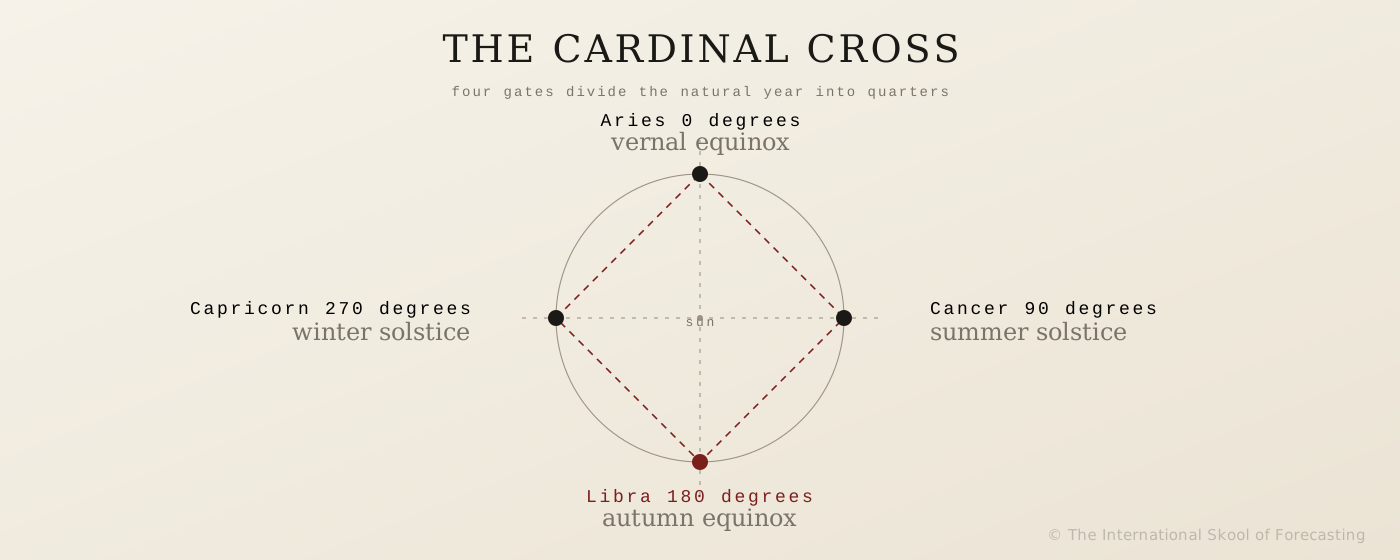
Method plate — solar timing gate Solar year cardinal cross showing the four seasonal gates used in solar timing work
Solar-degree work starts with the market's relationship to the solar year, then narrows into specific reversal windows drawn from prior turns and tested against current structure.
Inside this work

The geometry of time: how solar motion becomes a market calendar.

From the desk of Jonathan Evans — 11 minutes

Gann's most famous claim — documented by independent journalist Richard Wyckoff in 1909 — was a 92.3% win rate over 25 consecutive trading days. Modern traders dismiss this as either fabrication or luck. Having spent a decade studying how he actually did it, I believe it was neither.

The key was Time by Solar Degrees. Instead of counting forward in calendar days from a prior top or bottom — which is what most traders do — Gann counted forward in solar degrees. The Sun moves approximately one degree per day. But Gann didn't count days; he counted the Sun's actual position in the zodiac and projected forward to the degrees that corresponded to prior major turns.

The result was a timing system with a completely different character to anything based on calendar arithmetic. Where calendar counting drifts and loses precision, solar degree counting stays anchored to the actual astronomical event that Gann believed drove the market's turning points.

What 80—90% directional accuracy means.

Before you read this number and make a decision, understand what it is and is not. It refers to the directional bias on named reversal windows — periods where the solar degree analysis flags a high probability of a market turn. Within those windows, the market turns in the direction of the composite analysis approximately 80—90% of the time in the historical dataset.

It does not mean the market will move 80—90% of the time on every day you trade. It means that when the method identifies a reversal window, the probability of a turn is meaningfully elevated. That is a real edge. It is not a guarantee.

What solar-degree timing actually studies.

Most traders count days because days are easy. Gann used the Sun because solar motion gives the forecaster a precise 360-degree timing wheel. A prior top or bottom is not just a date. It is a degree. When the Sun returns to related degrees, the market often reaches a sensitive timing point.

This is why the method has a different quality from simple anniversary counting. Anniversary dates are part of the work, but they are not the whole work. The serious student learns to translate market history into solar position, project related degrees forward, and then compare those time windows with price, cycle pressure, eclipses, seasonal turns, and the behaviour of the market as the window approaches.

The core methods inside the program.

Solar degree projection. Students learn how to take important historical highs and lows, convert them into solar positions, and project future sensitive degrees where the market may turn again.

The anniversary method. Students learn the plain-chart version of the work: how recurring dates around prior market extremes can reveal timing structure without requiring software.

Time clusters. One date is interesting. Several independent solar counts arriving in the same window are more important. The program teaches how to identify clusters and how to separate strong windows from weak ones.

Eclipses and reset points. Eclipses can act as major timing markers in Gann-style work. Students learn when they matter, when they do not, and why they should be treated as confirmation rather than superstition.

Final confirmation. The old work also used weather and seasonal phenomena as a narrowing tool. The program treats this carefully: not as theatre, but as an additional timing clue that may compress a broad window into a tighter area of attention.

How the method is used in modern markets.

The point is not to stare at the sky and ignore the chart. The point is to know when the market is entering a historically sensitive window, then watch price more carefully as it arrives. A solar-degree date with no market response is noted and reviewed. A solar-degree cluster that arrives with exhaustion, divergence, cycle pressure, or a known support/resistance area deserves more attention.

This makes the work practical for stocks, indices, commodities, crypto and currencies. The market has its own vibration, but the calendar is the same. The student learns how to tune the method to the market being studied rather than assuming every asset responds identically.

What the student learns to stop doing.

The first thing this work removes is blind calendar counting. A simple 30, 60, 90, or 365-day count can be useful, but it is not the full method. Solar degree work teaches the student to anchor time to the actual celestial position, not to a rough human calendar. That distinction is why the method belongs to Gann's deeper work rather than ordinary date counting.

The second thing it removes is hindsight comfort. It is easy to explain a turn after the market has moved. The hard work is naming the window before the move. Students are trained to mark the dates in advance, watch what the market does as it approaches them, and then review the accuracy honestly.

The third thing it removes is dependence on software. The program includes automation, but it also teaches the plain logic. Students should be able to understand what the tool is calculating rather than treating it as a black box.

The Automated Solar Counting Spreadsheet.

The most practically significant part of this program for most students is the Solar Counting Spreadsheet. This is a custom-built Google Sheet that automates all of the solar degree calculations — the work that would take an hour by hand happens in seconds. You enter a date and a market; the sheet produces the solar degree projections forward in time.

It was built because I noticed that most students who understood the method intellectually were not using it consistently — because the calculation work was too time-consuming for live trading. The spreadsheet removes that barrier entirely.

What is included.

The program includes the full solar-degree training, the automation spreadsheet, the anniversary-date method, advanced confluence work, eclipse timing, and the practical process for narrowing broad windows into usable dates. The source sales material describes this as a complete 15-plus module system; the live page presents it more plainly, but the core promise is the same: students are taught the full timing process rather than given isolated examples.

The goal is to make Gann's solar timing usable. Not easy in the shallow sense, and not magical, but usable by a serious student who is willing to mark the dates, compare the windows, and build a review record.

Who this is for.

This program is for the student who wants future reversal windows on the calendar before the chart makes them obvious. It is especially useful for traders who already understand price but want a stronger timing framework. It is not a beginner's trading course, and it is not a promise that every date produces a reversal.

The value is in the discipline: identify the solar window, look for confluence, wait for market response, and review the result. That process is what turns Gann's old timing language into a modern forecasting skill.

What makes the method difficult.

The difficulty is not the arithmetic. The spreadsheet can handle that. The difficulty is interpretation. A date can be important without producing the exact move the student expected. A window can mark a high, a low, a volatility expansion, a false break, or a change in market character. The student has to learn how the market is responding to the time point.

This is why the program is taught over the shoulder. You need to see the work applied, tested, and reviewed. Reading that Gann used solar degrees is not enough. You need to see how a prior turning point becomes a future window, how a cluster is formed, and how the market is judged as it moves into the date.

How it fits with the other methods.

Solar-degree timing is strongest when it is not used alone. A solar window inside a McWhirter monthly bias has more meaning. A solar turn that lands near a dominant cycle low has more meaning. A solar date that appears during a Financial Time Table danger phase has more meaning. This is why the Skool treats the methods as a body of work rather than isolated tricks.

The method gives the student precision. The other methods give environment. Together they help answer the question a forecaster actually cares about: is this window important enough to act on, or is it just another date on the calendar

Why this method is difficult to learn from books.

Solar-degree work can look simple when it is reduced to a sentence: count degrees from one important point to another and watch for repetition. The difficulty is not the sentence. The difficulty is knowing which points matter, which counts are clean, which anniversaries are noise, and how to judge a market as it approaches the calculated window.

This is why the program is not written as a manual and left there. A manual can list the rules. It cannot easily show the hesitation, the rejection of weak evidence, the comparison between markets, or the moment where a cluster becomes strong enough to mark as a serious timing window.

The real edge is selectivity.

Students often think the edge is finding more dates. It is not. Any trader can flood a calendar with dates until every week appears important. That creates confusion, not precision.

The edge is learning which dates deserve weight. A solar-degree student has to compare prior highs, prior lows, anniversary counts, ingress points, eclipse pressure, seasonal repetition and the current behaviour of price. The strongest windows are not random marks. They are clusters where time evidence gathers naturally.

How the spreadsheet changes the work.

The automated spreadsheet is included because manual calculation creates two problems. First, it slows the student down. Second, it introduces avoidable errors. If the calculation is wrong, the forecast window is wrong before the analysis has even begun.

The tool does not replace judgement. It removes friction from the calculation stage so the student can spend more time on the important work: comparing the window against the chart, asking whether other methods agree, and reviewing the result after the market responds.

The buyer this page is speaking to.

This program is for the trader or researcher who has already learned that price is often late. They may have studied chart patterns, liquidity, breakouts and indicators, but they want a way to mark time in advance. They do not want another setup. They want a method for asking when a market is most likely to change character.

If you are looking for a signal that removes responsibility, this is the wrong program. If you are willing to study a precise timing method, test it against your own markets, and learn the discipline of waiting for high-quality windows, this is one of the most practical methods in the Skool.

The video curriculum.

The course lessons show a clear progression. The student begins with foundational principles: what time cycles are, why solar geometry matters, and how market dates can be treated as measurable time relationships rather than random calendar marks.

The next phase teaches the standard solar-degree calculation. This includes manual calculation, the overview of the method, and the process of forecasting major swings. The manual work matters because it stops the student from becoming dependent on a spreadsheet before they understand what is being counted.

The program then moves into the proprietary simplified application, the automated spreadsheet, and case-study work. The public page can name that structure, but it should not publish the private rules. The sale is the guided method, the applied examples, and the discipline of judging which windows deserve attention.

The case-study layer.

The video lessons include modern case-study work, including 2024 analysis and Nifty50 application, plus advanced confluence using lunar cycles and weather patterns. That should be visible on the sales page because it proves the course is not a generic lecture about solar degrees. It is applied chart work.

Case studies are where the student learns what a timing window looks like before and after the event. They also learn the less glamorous part of the work: which windows are ignored, which are downgraded, and which become more important because several timing layers gather in the same region.

Begin the Study

Lifetime access — all future updates — no refunds — NDA required

No-refund policy, NDA, and community verification.

The system is delivered in full on enrollment. There are no refunds. An NDA and identity verification are required. Before committing, read the free library essay On Solar Ingress which introduces the underlying principle.

Community verification. Before access is granted, you will be required to submit a verification photo — your face, beside your government-issued photo ID — via our secure portal. Sensitive numbers (driver's licence number, passport number) may be redacted; we check only your full name, photo, and address to confirm you are the legitimate purchaser. A member of our team reviews each submission manually. Access is granted after approval.

This step protects every member of the community. The material is not distributed anonymously. Every student in this program has been verified. You will be too.

Disclaimer: Educational purposes only. Not financial advice. All markets carry substantial risk. Past performance is not a guarantee of future results. The "80—90% directional accuracy" figure refers to historical backtesting results and is not a guarantee of future performance. Consult a qualified financial professional before making any investment decision.