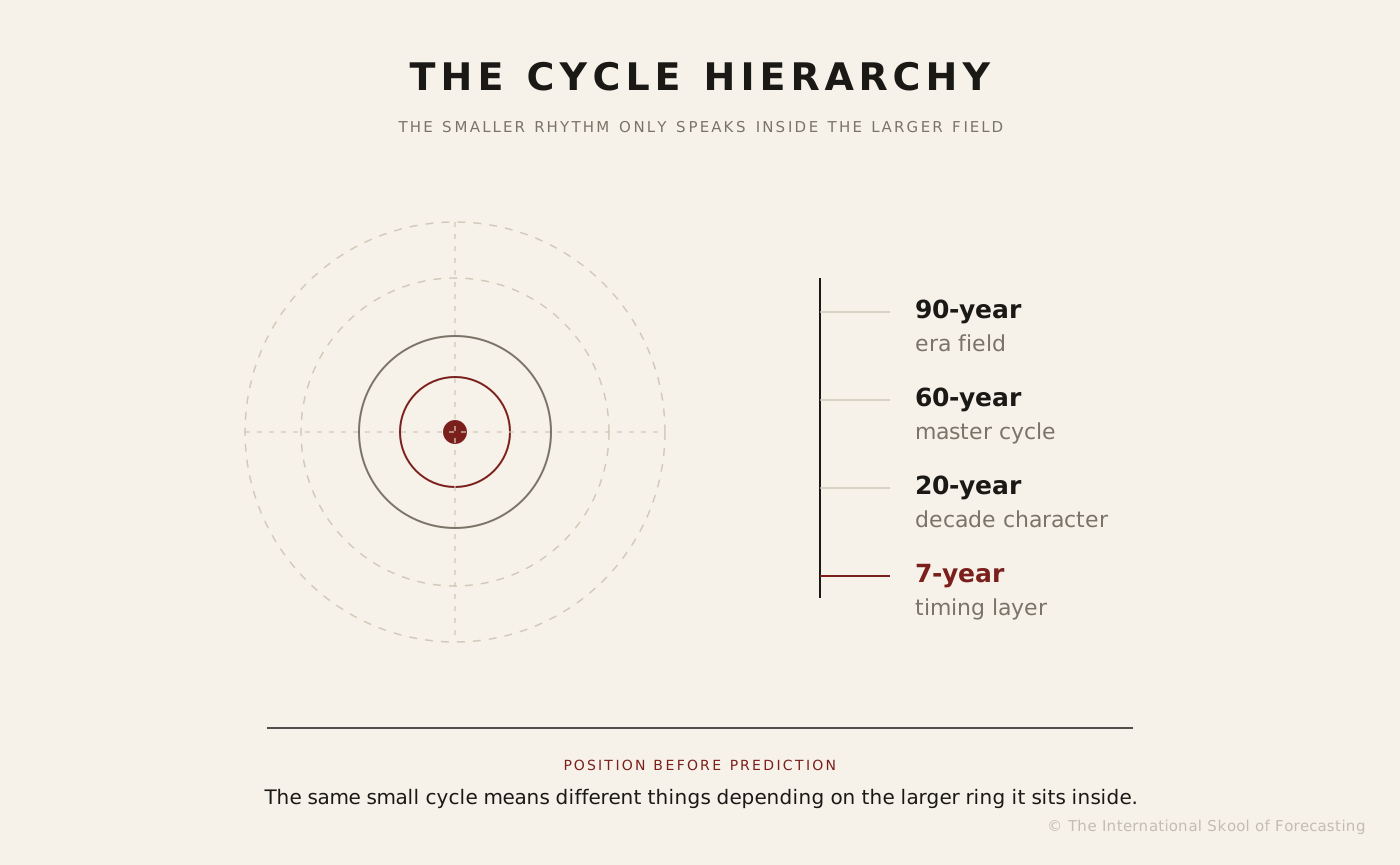
A single cycle can look persuasive and still be wrong because a larger rhythm is in control. Wheels Within Wheels teaches the hierarchy problem: how to find the dominant rhythm, read translation, and judge when several timing wheels gather into a window worth watching.
Forecasts fail when every cycle is treated as equal. The work is not just finding cycles; it is knowing which one has authority.
This is the course for turning scattered cycle observations into a disciplined forecast map.
Instant lifetime access including TradingView indicator and cycle database. Strict no-refund policy. NDA and identity verification required on enrollment.
Also included in The Market Forecaster (AUD $6,997).
From the desk of Jonathan Evans — 11 minutes
In 2011, I lost over $50,000 in the silver market. Not because I was careless. Because I was using the right analysis framework on the wrong timeframe, and I had no way to know it. The "experts" on television were calling silver a can't-miss trade. My charts confirmed the setup. I bought confidently. Within 48 hours, I had lost over $50,000.
What I didn't know — what no one on television mentioned — was that silver was at a mathematically precise multi-year cycle peak. Had I been able to identify the dominant cycle, I would have known that the setup I was entering was happening at the worst possible point in the long-wave pattern. The price action looked bullish. The cycle said otherwise. The cycle was right.
That loss eventually drove me to build what became this program: a complete system for identifying the dominant cycle in any market, understanding where the current price sits within that cycle, and projecting the cycle forward to identify the next inflection point in advance.
Every market has what I call a "heartbeat" — a dominant recurring cycle that underlies its price action. In Gold, the heartbeat is approximately 65 trading days. In the S&P 500, there are several nested cycles operating simultaneously, including short rhythms near 40 trading days. Bitcoin has a well-documented 4-year cycle that is now in its fourth confirmed iteration.
Finding the heartbeat is the first skill this program teaches. The second is projecting it forward: once you know the dominant cycle length, you can count forward from the last confirmed low to identify the probable timing of the next low. The third is understanding confluence: the points where the short-term, medium-term and long-term cycles all point in the same direction simultaneously. These are the "Black Swan Hunter" moments — the rare confluences that produce the biggest, fastest moves in market history.
Dominant rhythm. The student learns how to identify the cycle that is actually controlling the market, rather than drawing arbitrary counts after the fact. This is the difference between serious cycle work and decoration on a chart.
Cycle age. A trend behaves differently at the beginning of a cycle than it does near exhaustion. Late-cycle rallies can look strong while the underlying rhythm is already old. Students learn to read when a trend is young, mature, extended, or vulnerable.
Confluence. The largest moves tend to appear when several cycles line up at once. This program teaches how to recognise those alignments without forcing every cycle to agree. Confluence is powerful only when it is earned by the data.
Projection. Time is studied first, but price still matters. Students learn how timing windows can be paired with price structure so that a forecast has a practical area of interest rather than a vague calendar date.
The common mistake is to find a cycle that fits the past and assume it will control the future. That is curve-fitting. A real cycle has to keep working after it is identified. It has to explain prior turns, project forward into new data, and survive the discipline of review.
The second mistake is to study only one timeframe. A daily cycle can be bullish while the medium-term cycle is exhausted. A short-term bottom can occur inside a larger topping structure. This is why the program is called Wheels Within Wheels: the market is a layered timing machine, not a single sine wave.
The third mistake is to ignore failure. Cycles expand, contract, invert and occasionally fail. The serious student learns how to adapt when the market shifts rather than pretending the first count was sacred.
Most traders experience the market as a sequence of surprises. A strong trend suddenly fails. A breakout collapses. A market that looked dead begins moving before the news has changed. Cycle work does not remove uncertainty, but it changes the student's relationship to these moments. If the market is approaching the expected age of a cycle low, weakness stops looking like random punishment and starts looking like a potential preparation phase.
The same is true near cycle highs. When a trend is late in its rhythm, price can still look impressive. This is where many traders make their most expensive mistakes. They confuse a mature cycle with a new opportunity. Wheels Within Wheels teaches the student to ask whether the trend has time left, whether the rhythm is confirming, and whether a larger cycle is quietly preparing to dominate the smaller one.
The program does not stop at identifying time windows. Once the dominant rhythm is mapped, the student learns how to bring price back into the work. Time identifies when a turn is likely to matter. Price helps define where the market may respond. When those two forms of evidence converge, the forecast becomes more useful.
This is where the method becomes practical for serious traders. The student is not left with a vague claim that a market is "due" to turn. They learn to identify the window, study the cycle age, watch price behaviour into the window, and review whether the market has respected the timing structure. That is a proper forecasting process.
On February 1st, 2024, our cycle work identified a dominant 65-day cycle in Gold due for a major bottom. All the news was bearish. The mainstream view was continued weakness.
Gold rallied $300 from the February low. Students who had identified the 65-day cycle bottom were positioned for one of the cleanest moves of the year.
The program includes the complete video training on identifying, projecting and reviewing dominant cycles. It also includes the private Master Cycle Lengths Database, which gives students a starting point for major markets rather than forcing them to spend months building a reference library from scratch.
Students also receive the proprietary TradingView cycle indicator. The tool is not a substitute for understanding. It is a way to make the work visible on the chart once the method has been taught. Used properly, it helps the student see whether price is moving with the dominant rhythm, fighting it, or approaching a pressure point.
The deeper outcome is not that the student memorises a few market cycle lengths. The outcome is that they learn to think structurally: identify the heartbeat, locate the market inside it, watch for confluence, and review the forecast honestly when the market either confirms or rejects the count.
This program is for traders and researchers who already know price alone is not enough. It is especially useful for students who can read a chart but still feel they are reacting late. If you want to understand why a market becomes vulnerable at one point and resilient at another, cycle architecture is the missing layer.
It is not for someone looking for a push-button indicator. The tools matter, but the student's judgement matters more. The purpose is to teach you how the work is done so that the indicator and database support your analysis rather than replacing it.
Confluence is one of the most abused words in market education. Traders often collect unrelated reasons for a trade and call the pile "confluence." That is not what this program means. In cycle work, confluence means independent timing structures pointing into the same window: a dominant cycle, a shorter rhythm, a longer rhythm, and sometimes an external timing method all gathering around the same period.
When that happens, the market can move with unusual speed because several layers of time are releasing pressure together. This is why major turns can feel sudden to the public while being visible to the cycle student weeks in advance. The event may be surprising. The window does not have to be.
The student learns to separate real confluence from forced agreement. If a count has to be tortured into place, it is not evidence. If several clean counts arrive naturally in the same window, the market deserves attention.
Every cycle forecast should be reviewed after the window passes. The review asks whether the turn occurred, whether the cycle inverted, whether the market accelerated instead of reversing, and whether the count was too short, too long, or still valid but expressed through a different market.
This review process is central to the program. Without it, cycle work becomes decoration. With it, the student builds a living record of which rhythms are active, which markets are clean, and which counts deserve trust.
This program includes my proprietary "Heartbeat" indicator for TradingView — custom-coded specifically for cycle identification. It automates the process of finding and displaying the dominant cycle in any market on any timeframe. It has been offered to professional funds for single-license fees upward of $4,000. You receive it as part of this program.
The Master Cycle Lengths Database is the other tool that separates this program from a theoretical education. It is a private database of the dominant cycle lengths for all major markets I have researched — commodities, indices, currencies and crypto. Rather than spending months finding the heartbeat for each market yourself, you start with the work already done.
Cycle analysis is easy to imitate badly. A trader can draw a low-to-low count, project it forward, and call the next date a forecast. That is not the standard taught here. A true cycle forecast has to survive contact with market character, proportion, amplitude, historical repetition and the presence or absence of supporting time counts.
Wheels Within Wheels is advanced because it teaches the student to stop treating cycles as a single line on a chart. Markets often move through nested rhythms. A shorter rhythm may operate inside a larger rhythm. A dominant count may fade while another becomes active. A window may invert. A forecast can be directionally wrong but still time a volatility event correctly. Those distinctions are what separate useful cycle work from decorative cycle work.
The student is not left with a list of cycle lengths and a vague instruction to "apply them." The program shows how Jonathan studies the chart, tests candidate rhythms, rejects weak counts, compares clean repetitions, and builds a forecast window only when the evidence is strong enough to deserve attention.
This is the reason the program belongs in video form. Cycle selection is not only a formula. It is a judgement process. You need to see what gets ignored, what gets kept, what counts as clean evidence, and when a forecast should be downgraded because the market is no longer respecting the rhythm.
The goal is for the student to build a living cycle record for the markets they follow. That means identifying the dominant rhythm, knowing when it has been reliable, knowing when it has failed, and understanding how shorter and longer cycles combine around important windows.
Used properly, the method changes the student's relationship with surprise. A major move can still be emotionally difficult, but it should not feel random when it appears inside a window that has already been marked, compared and reviewed. The public experiences the move as a shock. The trained student has already been watching the time pressure build.
The Wheels Within Wheels course is not only a theory course. It begins with cycle definition, measurement, translation patterns, trend characteristics, primary-cycle work and the problem of conflicting patterns. Then it moves into practical chart work where cycles are located, tested, translated and modelled against real markets.
The video lessons include Bitcoin cycle studies, blank-chart cycle discovery, planetary timekeepers, short-term cycles, model building, the Black Swan Hunter Atlas, ABC translation, Telstra framework work, Nifty50 analysis and proof, plus the LIT Cycle Analysis Framework. That matters because it tells the buyer this is not decorative cycle talk. It is repeated market application.
The public essay gives the map. The course shows the work: what gets measured, what gets rejected, when a window earns attention, and how the review is done after the market speaks.
The exact working templates, private cycle database, indicator logic, atlas process, and over-the-shoulder chart examples stay inside the program. This page explains the promise clearly; the course delivers the working desk.
That distinction matters. A serious student does not need another inspirational article about cycles. They need to watch the method being applied, see weak counts rejected, and learn how a real timing window is built before risk is placed anywhere near a market.
Cycle students often fail because they only learn the theory. They can explain what a cycle is, but they cannot find one on a live chart without forcing the evidence. The practical examples are designed to solve that problem.
Watching cycles found on Bitcoin, Nifty50 and individual equity examples teaches the student how messy real charts can be. The student sees the difference between a clean rhythm, a weak rhythm, an inverted rhythm and a market where several rhythms are competing. That judgement is the product.
Includes TradingView indicator and Cycle Database — Lifetime access — No refunds
The Charter Membership pricing is permanently closed. The current price is AUD $2,997. Strict no-refund policy. NDA and identity verification required on enrollment. Read the free library essay Wheels Within Wheels before committing.
Community verification. Before access is granted, you will be required to submit a verification photo — your face, beside your government-issued photo ID — via our secure portal. Sensitive numbers (driver's licence number, passport number) may be redacted; we check only your full name, photo, and address to confirm you are the legitimate purchaser. A member of our team reviews each submission manually. Access is granted after approval.
This step protects every member of the community. The material is not distributed anonymously. Every student in this program has been verified. You will be too.
Disclaimer: Educational purposes only. Not financial advice. All markets carry substantial risk. Past performance is not a guarantee of future results. Consult a qualified financial professional before making any investment decision.