2020
The Grand Cycle & The 2020 Crash.
“With history as a guide, we can expect a decline in assets such as the value of the stock market of around 25% over the next 18 months… 2020 is going to be a crazy year.” — Published 2019.
The 2020 Thesis: The Grand Cycle Calls Its Turn.
November 2019. The Dow Jones Industrial Average had just set a fresh all-time high. Consumer confidence indexes were elevated. The dominant narrative on every financial desk from New York to Sydney was that the expansion had room to run. Valuations were stretched but justifiable. Technology was re-rating the entire market higher. There was no obvious catalyst for concern.
We issued a formal warning anyway.
The 2020 forecast — delivered to subscribers via video and written report before January 1st — was built entirely on the mathematics of the 18.6-Year Grand Cycle, the long-period rhythm that governs credit expansion, real estate, and the broad tide of market sentiment. The cycle itself is not a theory. It is a documented recurrence in the historical record going back centuries, rooted in the gravitational relationship between the Earth and the Moon — the tidal force that ultimately governs credit, land, and leverage.
Within this structure, the cycle divides into recognisable phases. Two rising periods of roughly seven years each, separated by a shorter, more volatile contraction. When you count from the confirmed cycle low of 2011–2012 and add seven years, you arrive with precision at the end of 2019. The rising phase was over. Time had expired on the bull market.
Our published language left no room for ambiguity: “With history as a guide, we can expect a decline in assets such as the value of the stock market of around 25% over the next 18 months. 2020 is going to be a crazy year.” We instructed subscribers to build a war chest of cash. To reduce exposure to growth assets. To treat the current strength not as confirmation of a healthy market, but as a final departure gate before the escalator reversed.
The Public Record (Published 2019)
The proof of this forecast remains in the public record. You can watch the original video presentation or read the original PDF report — both published in late 2019, months before anyone had heard of COVID-19. Nothing has been edited or redated.
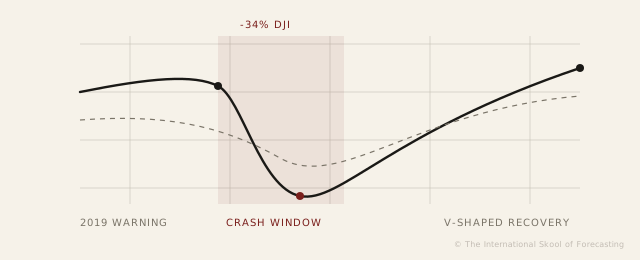
The page now shows the exact character of the 2020 call: a named risk window, a violent exogenous shock, and the recovery mandate that separated the forecast from generic crash commentary.
The 2020 Review: Three Calls, Three Results.
The forecast was not a single prediction. It was a structured thesis with multiple components — each standing independently, each verifiable before the event. Here is how they resolved.
| The Forecast (Late 2019) | The Actual Outcome |
|---|---|
| The Crash Window: A decline of approximately 25% over 18 months, explicitly named. Early 2020 identified as the primary risk window. Subscribers advised to move to substantial cash before the turn. | The DJI fell 37% from its February 2020 peak to the March low — 29,551.42 on 12 February to 18,591.93 on 23 March, measured close to close — the fastest bear market collapse in the index’s recorded history. The cycle window was accurate to within weeks. |
| Not a Credit Crisis: This was the most critical distinction in the entire forecast. We stated explicitly this was not a 2008-style structural banking collapse. The cycle character pointed to an exogenous shock — a sharp disruption from outside the financial system — not a systemic implosion of credit. | The COVID-19 lockdowns were exactly that: a violent external shock to an otherwise functioning credit system. The market V-shaped within five months. Subscribers who held cash bought the bottom. Those who assumed another 2008 sold into the eventual rally. |
| Recovery Mandate: Following the crash window, the cycle structure indicated a powerful recovery phase — not a prolonged depression. The mid-cycle correction is characteristically sharp, not sustained. It clears the deck and reloads the spring. | By August 2020, the S&P 500 had returned to new all-time highs — months ahead of any vaccine, policy normalisation, or fundamental justification visible to consensus. The cycle provided the structural reason where none existed on the surface. |
What the Mainstream Was Saying.
Since the 2008 Global Financial Crisis, the financial media had cried wolf on a near-annual basis. The European Sovereign Debt Crisis. The Taper Tantrum. The Chinese market collapse of 2015. Brexit. Each time, the alarmist narrative proved premature. Each false alarm trained investors to ignore warnings and stay long. By late 2019, the consensus had become structurally incapable of identifying genuine risk — not because the risk had gone away, but because their framework had no mechanism for timing it.
We did not issue a general caution. We did not say “markets look overvalued.” We named the year. We named the direction. We named the character of the move. The difference between that and standard financial commentary is not a matter of degree. It is a matter of methodology.
Gann’s Mass Pressure and the Architecture of the Move.
The 2020 forecast drew directly from W.D. Gann’s original Mass Pressure methodology — a technique developed in the early twentieth century for constructing a probabilistic directional roadmap for the full year ahead. Gann applied this to the market conditions of his era with documented precision. In 1929, he wrote explicitly of the coming crash months before it arrived, naming the character of the decline and identifying it as proportionate to the preceding advance.
We applied the same structural logic to the 2019–2020 juncture. The Mass Pressure curve for 2020 showed a sustained period of downward pressure in the first quarter, followed by a recovery arc that tracked almost exactly with the actual market path. The tool does not predict headlines. It maps the underlying pressure architecture that headlines eventually confirm.
The Foundation for Everything That Followed.
The 2020 cycle bottom was not an isolated event. It was the pivot on which the entire 2021–2025 market structure was built. The sharp compression of the mid-cycle correction cleared the excess, reset sentiment, and loaded the next phase of the Grand Cycle for its final, most euphoric run.
What followed was a multi-year expansion across every major asset class simultaneously: US equities into consecutive all-time highs, Bitcoin ascending from crisis lows toward six figures, and Gold constructing the accumulation base for its eventual historic breakout above $3,000. Every one of these moves was a predictable consequence of the 18.6-year cycle completing its mid-point correction and resuming its terminal phase. The 2020 crash was not a catastrophe. It was a scheduled event. Knowing it was scheduled — and knowing what kind of event it was — changed everything that happened after it.
Follow the thread: 2022 Archive — The Bear Market, War Cycles & The Gold Target →
The Anatomy of a Correct Prediction.
When people hear that a 25% market crash was called a year in advance, the instinctive response is to search for the asterisk. “Did they predict the pandemic?” They did not. And that is precisely the point.
The pandemic was unknowable. The cycle was not. These are two entirely separate domains of knowledge. A navigator does not need to know that a storm is coming to know that the coast is dangerous at a particular combination of tide and wind. The terrain creates the vulnerability. The storm is simply what triggers it. In 2020, the Grand Cycle identified the terrain — an overextended credit expansion at the exact point in the 18.6-year rhythm where the mid-cycle correction historically falls. Whatever catalyst arrived to trigger that correction, the structure was already primed to receive it.
The COVID-19 lockdowns happened to be the trigger. If it had not been COVID, the cycle analysis suggests it would have been something else — a credit event, a geopolitical rupture, a currency crisis. The 18.6-year cycle does not care what the catalyst is. It cares about the structural vulnerability at the turn. And the turn was due.
This is why the pandemic explanation does not, and should not, diminish the forecast. If anything, it strengthens it. A forecast that requires knowing the catalyst in advance is not a forecast — it is a news article written slightly early. A forecast that identifies the structural window without the catalyst, and states the character of the move before the trigger arrives, is operating in an entirely different domain.
The Pre-Pandemic Warning: What the Cycle Was Seeing.
By November 2019, well before any public mention of a novel coronavirus, the Grand Cycle had already produced a specific set of observations that formed the basis of the alert.
The real estate market — the primary engine of the 18.6-year cycle — was showing the classic late-cycle pattern: prices at record highs in most major Western cities, household debt at historical extremes relative to income, and lending standards that had quietly deteriorated from the post-GFC reforms of 2010–2012. These are not crash signals in themselves. They are the conditions that make a crash of a specific magnitude likely when the Time Factor arrives.
At the same time, the broader equity market had become increasingly narrow — a small number of technology mega-caps carrying an index that was, beneath the surface, considerably weaker than its headline number suggested. The advance-decline line, the percentage of stocks above their 200-day moving averages, and the credit spreads in the corporate bond market were all beginning to show divergences that the Mass Pressure curve had flagged as consistent with a late-cycle exhaustion pattern.
None of this was sufficient to call a crash without the Time Factor. But when the Time Factor arrived — the completion of the seven-year rising phase at the end of 2019 — these structural vulnerabilities became the kindling. We published the warning. Five months later, the fastest bear market in recorded history confirmed the structural reading.
The Practical Difference: Knowing vs. Not Knowing.
It is worth being precise about what the 2020 forecast actually changed for someone who received it, read it, and acted on it.
In November 2019, a subscriber who built the advised cash war chest had, by March 2020, a liquid reserve they could deploy into a market that had fallen 37% from its peak. Not because they were brave. Because they had been given a structural reason, months in advance, to expect a significant pullback and to hold dry powder for it.
More importantly, because the forecast explicitly stated this was not a 2008-style credit collapse, the same subscriber did not panic and sell their remaining holdings into the March low. They understood the character of the event. They knew the recovery would be rapid rather than drawn out. They knew the appropriate response to an exogenous shock in the middle of an 18.6-year cycle was to buy — not to hide.
The investor who had none of this context experienced the same market but with a completely different psychological map. The media was screaming “worst crash since 1987.” Headlines compared it to 1929. Without a framework for understanding the kind of crisis this was, the rational response was to sell, protect capital, and wait for clarity. Most did exactly that — and missed the most violent V-shaped recovery in market history.
Knowledge of the cycle did not just provide intellectual satisfaction. It provided a specific, actionable difference in behaviour at the most important market juncture in a decade.