2022
The 84-Year War Cycle, Taiwan & The Pandemic Resonance.
“I get the past history and find out what cycle we are in and then predict the curve for the future, which is a repetition of past market movements.” — W.D. Gann
The Thesis
The 2022 Thesis: When Three Cycles Align.
The 2022 forecast was written in the immediate aftermath of the COVID-19 pandemic — a moment when the entire investment community was in a state of disoriented optimism. Stimulus cheques had inflated every asset class. Retail participation in markets was at an all-time high. Inflation was described as “transitory.” The consensus view was that 2022 would be a continuation of the post-pandemic recovery.
We saw something different. Three independent cycle systems — each derived from entirely different historical methodologies — were all pointing at 2022 as a year of elevated disruption. When three clocks strike the same hour, you do not dismiss it as coincidence.
The first was Gann’s 100-Year Cycle. In his 1927 novel Tunnel Thru the Air, Gann documented how the epidemics of the 1820s rhymed with the Spanish Flu of the 1920s exactly one century later. Extending that same 100-year harmonic forward placed 2020 as the pandemic window — and 2022 as the year the world would be forced to navigate the aftermath of that disruption while a new geopolitical crisis simultaneously erupted.
The second was the 84-Year American War Cycle. Counting backward from the major US military engagements reveals a consistent rhythm: the Civil War (1861), the First World War (1917), and the Second World War’s Pacific theatre (1941). Adding the cycle forward from 1941 produces 2025 as the outer boundary, with the approach period — the build-up of geopolitical tension — falling precisely in 2022.
The third, and most specific, was a 360-year lookback to 1662 — the year the Dutch formally surrendered Taiwan to China. A 360-year resonance is not a commonly applied tool. Most analysts have never heard of it. But in the structure of historical cycle work, a full 360-degree revolution of the great synodic cycles produces exact thematic repetition. The 1662 event pointed unambiguously at Taiwan as the defining geopolitical flashpoint of 2022. We named it explicitly.
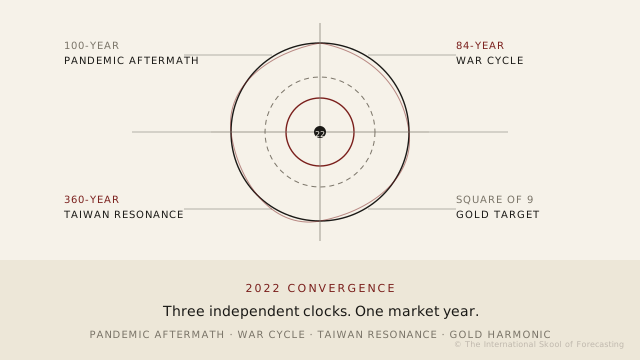
This plate breaks the thesis into the visual logic of the page: three independent timing systems converging into the same market year.
The 2022 Review: Forecast vs Outcome.
Four separate forecast components were issued for 2022. Each was a discrete, named prediction — not a vague directional bias. Here is the record.
| The Forecast (Late 2021) | The Actual Outcome |
|---|---|
| US Equities — Bear Year: The Decade Cycle (years ending in ‘2’) consistently produces sharp trend reversals. The Mass Pressure curve indicated a first-quarter peak, heavy mid-year pressure into August, and a late-year recovery. We identified this as a significant bear market year — not a collapse, but a structural reset of the 2020–2021 advance. | 2022 became the worst year for US equities since 2008. The S&P 500 fell 19.4%. The NASDAQ dropped 33%. The peak arrived in January, the low in October — almost exactly as the Mass Pressure curve described. The late-year recovery then trapped the last of the aggressive bears. |
| Taiwan — Brink of War (360-Year Resonance): The 1662 Dutch surrender pointed directly to 2022 as the year Taiwan would dominate the global conflict narrative. We specifically described the scenario as a “brink of war” tension resonant with the 60-year Cuban Missile Crisis cycle of 1962. | In August 2022, Nancy Pelosi’s visit to Taiwan triggered China’s largest-ever live-fire military encirclement of the island — four carrier strike groups, simultaneous missile exercises across six maritime zones. Mainstream geopolitical analysts called it the most dangerous moment in the Taiwan Strait since 1996. Russia’s simultaneous invasion of Ukraine made 2022 the most geopolitically volatile year since 1962. |
| Gold Target — $1,621: Using Gann’s Square of 9, we extracted the primary harmonic support level for Gold assuming a bear cycle unfolded in 2022. The target was stated precisely at $1,621, with a secondary level at $1,581 below. This was published months before the Federal Reserve had begun its rate-hiking campaign. | Gold peaked at $2,070 in March 2022 and fell through the year as the Fed enacted its most aggressive tightening in 40 years. The September 2022 cycle low: $1,620.32. One dollar below the stated harmonic target — within a rounding error of a mathematical price level identified months before the fact. |
| The Royals — 70-Year Resonance: We noted the 70-year cycle from Queen Elizabeth II’s accession in 1952 and the 20-year resonance from the Queen Mother’s death in 2002. We flagged 2022 as “an interesting year for the royals.” | Queen Elizabeth II passed away in September 2022, concluding the longest reign in British history. The cycle was precise to the year on a 70-year rhythm that extends back through three centuries of monarchical history. |
The investor without this framework in 2022 held through the entire drawdown in the dark — no context, no window, no understanding of when it would end. The October low was the precise cycle bottom we had identified months prior. Many capitulated at exactly that level, selling into the eventual recovery. Understanding why a market is under pressure, and for how long, is the difference between informed patience and expensive panic.
The Square of 9 and the $1,621 Target Explained.
The $1,621 Gold target deserves its own commentary because it demonstrates something important about this methodology: the price levels exist in the mathematics, independently of any news event or fundamental analysis.
Gann’s Square of 9 is a mathematical framework that projects harmonic price angles outward from key calendar points — particularly the Vernal Equinox of March 21st. These angles are not drawn on a chart after the fact. They are calculated from a fixed origin point and produce specific price nodes at specific angular distances. They do not care whether the Federal Reserve is hiking rates. They do not care about geopolitical headlines. They exist as mathematical harmonics in the price structure, and markets — consistently, repeatedly — find support and resistance at precisely these levels.
We identified $1,621 as the The Harmonic Price Anchor from the relevant Square of 9 origin. Gold bottomed at $1,620.32. The next level, $1,581, remained untested — meaning the primary harmonic held exactly. This is not backtesting. The target was stated in writing before the cycle unfolded.
For context on how the 2022 Gold low set up the 2023–2024 bull market: 2023 Archive — The Cycle Bottom & The Birth of the Bull →
The Bear Market Character: Why It Mattered to Know.
The difference between understanding a bear market and simply experiencing one is immense. In 2022, the standard financial media provided two predominant narratives: first, that inflation and rate hikes were temporary and would resolve quickly; then, as the year deepened, that the decline would worsen into a structural recession. Neither narrative provided a timing mechanism. Neither could tell investors when to hold, when to add, or when the selling was exhausting itself.
The cycle structure provided that mechanism. The Mass Pressure curve for 2022 had identified the October window as the probable cycle trough — months before it arrived. Not because of any fundamental analysis of corporate earnings or the Federal Reserve’s dot plots, but because the underlying cycle architecture demanded that a sufficient period of corrective pressure run its course before the next structural impulse could begin.
Investors who held that October context did not capitulate at the low. They watched the index reach 3,491 on the S&P 500 on October 13th and understood it as the probable trough rather than the beginning of something worse. Those who lacked the framework sold into exactly that low, locking in the maximum loss at the precise moment the cycle was setting up for the 2023 recovery.
The 84-Year Cycle and the War Character of the Decade.
The 84-year American War Cycle is one of the most consistent patterns in modern geopolitical history, and its implications extend well beyond what actually happened in 2022. The cycle is not simply about wars beginning — it is about the fundamental restructuring of global power that occurs at these junctures. In 1838, the transition from a post-colonial to a continental power structure. In 1861, the defining internal conflict that settled the nature of the American republic. In 1917, the emergence of America as a decisive global power. In 1941, the establishment of American hegemony.
Counting forward from 1941 produces approximately 2025 as the outer boundary of the cycle’s active window — with 2022 as the inflection point where the geopolitical restructuring accelerates. The Russia-Ukraine war, the Taiwan encirclement, the BRICS expansion, and the structural challenge to dollar hegemony are not isolated events. They are symptoms of the 84-year cycle doing what it has always done: forcing a fundamental renegotiation of global power arrangements at the designated historical juncture.
We identified this in the 2022 forecast. The implications are still unfolding — which is why the 2026 forecast remains the most consequential document currently in circulation.
The Pattern Matrix
The synodic resonance that built the 2022 forecast — historical back-look.