1. The Geometry of the Natural Year
Modern finance operates under the delusion that January 1st possesses mechanical significance. Analysts track year-to-date performance, project quarterly earnings based on a twelve-month Gregorian grid, and assume that the turn of the calendar year initiates a new economic phase. It does not. January 1st is an artificial construct — an administrative convenience adopted by the Roman Empire and later modified by Pope Gregory XIII. It has no correlation with the physical mechanics of the Earth or the solar system.
If a forecasting methodology bases its macro-timing on an artificial construct, its calculations will inevitably drift out of phase with reality. The natural year is not a straight timeline beginning in January; it is a circle. And structurally, that circle is divided into a strict 90-degree square by the transit of the Sun.
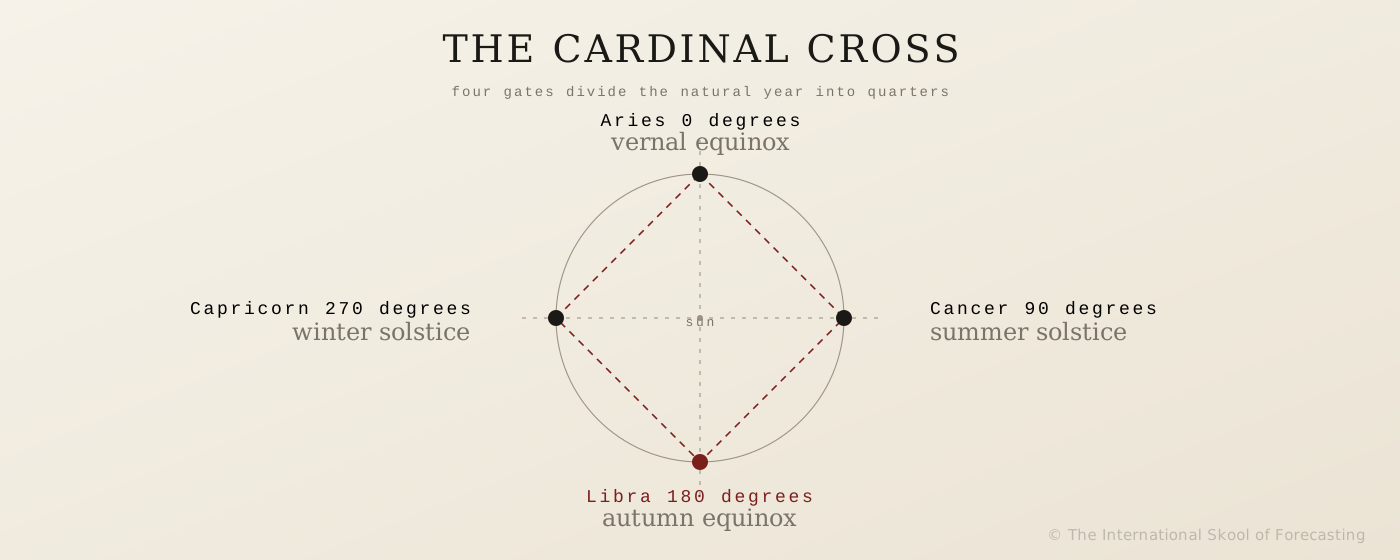
The four corners of this square are the Cardinal Signs: Aries, Cancer, Libra, and Capricorn. When the Sun enters one of these signs — an event known in Mundane Astrology as a Solar Ingress — it physically marks the Equinoxes and Solstices. These are not esoteric abstractions. They are the absolute structural pillars of the solar year, marking the points of perfect equilibrium, maximum light, and minimum light. Human beings, and the markets they drive, respond to these physical shifts in environmental energy.
2. The Four Gates Defined
W.D. Gann understood that market movement is merely human psychology responding to natural cycles. In his coded novel, The Tunnel Thru The Air, Gann placed immense emphasis on a specific biblical allegory to explain the most critical period of the market year: the time between the Winter Solstice (0° Capricorn) and the Vernal Equinox (0° Aries).
“For as Jonah was three days and three nights in the whale’s belly; so shall the Son of man be three days and three nights in the heart of the earth.” — Matthew 12:40
As decoded by researchers like Bonnie Lee Hill and Daniel T. Ferrera, the “Son of man” in this context is an allegorical reference to the Sun. The story describes the physical transit of the Sun as it symbolically “dies” on the cardinal cross of Capricorn during the Winter Solstice (around December 21st). This is the point of maximum darkness in the Northern Hemisphere.
For exactly three months (“three days in the whale’s belly”), the Sun remains in what Gann termed the grave of winter. The life force of the natural world is dormant. Finally, three months later, the Sun reaches 0° Aries at the Vernal Equinox (around March 21st). It crosses the equator, moving North, and daylight overtakes darkness. The Sun is “resurrected.” This is the true New Year of the natural cycle.
When the Sun hits exactly 0° of a cardinal sign, it crosses a threshold. The astrological tradition refers to this as casting a “Mundane Horoscope,” but the application is entirely mechanical. The chart drawn for the exact second of the ingress over a nation’s capital acts as a structural blueprint for the 90 days that follow.
- The Aries Ingress (March 21st): The “New Year.” The Aries ingress is the supreme chart of the year, dictating the primary macro bias for the next twelve months. It is the gate of initiation, often coinciding with fresh institutional capital flows.
- The Cancer Ingress (June 21st): The Summer Solstice marks the height of light. It is the gate of realization. In the markets, this ingress frequently marks a point of trend exhaustion — the moment when the euphoria of the spring advance burns out.
- The Libra Ingress (September 21st): The Autumn Equinox is the point of perfect balance, but it is unstable. Libra demands a reckoning. Historically, this ingress is associated with major market “shocks” and October panics.
- The Capricorn Ingress (December 21st): The Winter Solstice is the gate of foundation. The light is dead, and the old cycle ends. The Capricorn ingress sets the restrictive tone for the final quarter.
3. Gann’s Seasonal Rule and Trend Exhaustion
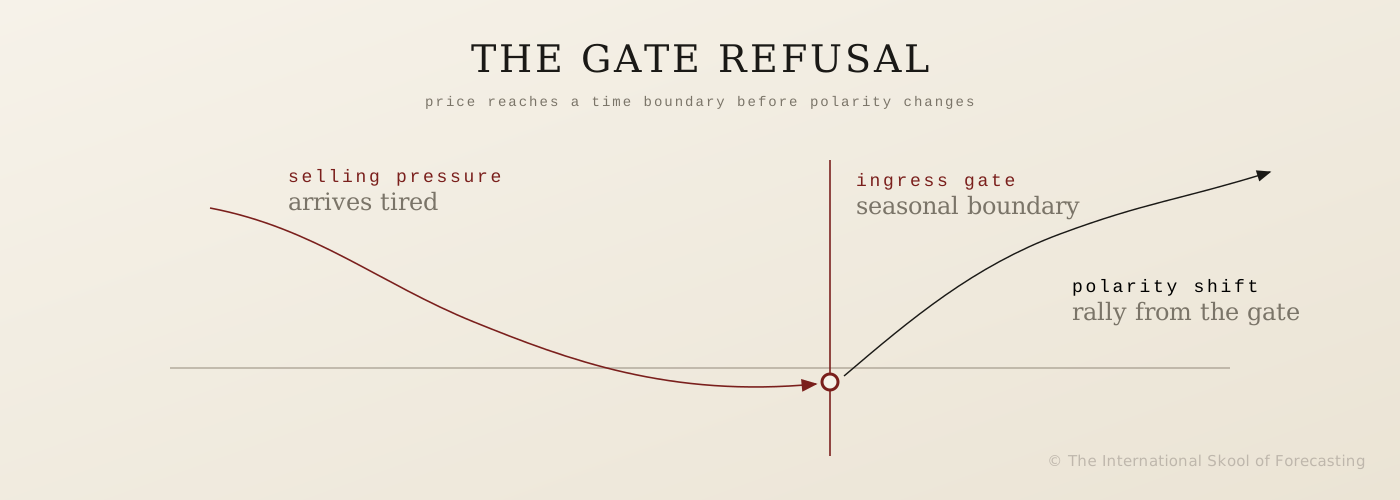
Because the ingresses represent absolute mathematical points of maximum stress or perfect balance in the solar cycle, they almost always correlate with significant market turning windows. A market trend will often exhaust itself exactly as a season exhausts itself.
“Watch the Sun’s entrance into the Cardinal Signs… if the trend is down into these dates, a sharp rally often follows.” — W.D. Gann
The logic is uncompromising. If a market has been declining heavily throughout the summer and is crashing into the Libra Ingress (September 21st), it is moving into a natural inflection point. The selling pressure is attempting to push through a “gate.” More often than not, the gate holds, the sellers exhaust their inventory, and the market sharply reverses course. This is not arbitrary technical support; this is the measurement of time forcing a change in polarity.
4. Defining Seasonal Bias
To understand how powerful the ingress mechanics are, we must look at how they physicalize in the real world. A chart pattern cannot destroy a soybean crop, but environmental forces can. In her advanced research, Bonnie Lee Hill demonstrated that specific planetary configurations occurring while the Sun is in the grave of winter (between Capricorn and Aries) physically dictate the supply of agricultural commodities for the coming year.
For example, when Saturn (restriction/cold) geometrically aspects Neptune (water) during the winter months, it triggers severe droughts. The lack of water destroys crop yields, forcing agricultural commodity prices to violently skyrocket in the summer. Conversely, Jupiter (expansion) aspecting Neptune in the winter triggers ideal growing conditions, creating bumper crops that crush prices. We are measuring the physical environmental forces that dictate supply, demand, and human sentiment.
At the International Skool of Forecasting, we do not use an Ingress merely to guess the exact day of a turn. We use it to establish the Seasonal Bias for the entire quarter.
When the Aries Ingress chart is cast, we analyse the planetary weight within that specific structure. We examine the condition of Jupiter (expansion), Saturn (restriction), and Mars (volatility). The synthesis of these forces determines whether the upcoming 90-day cycle will be inherently bullish, bearish, stagnant, or panicked. This is the ultimate leading indicator.
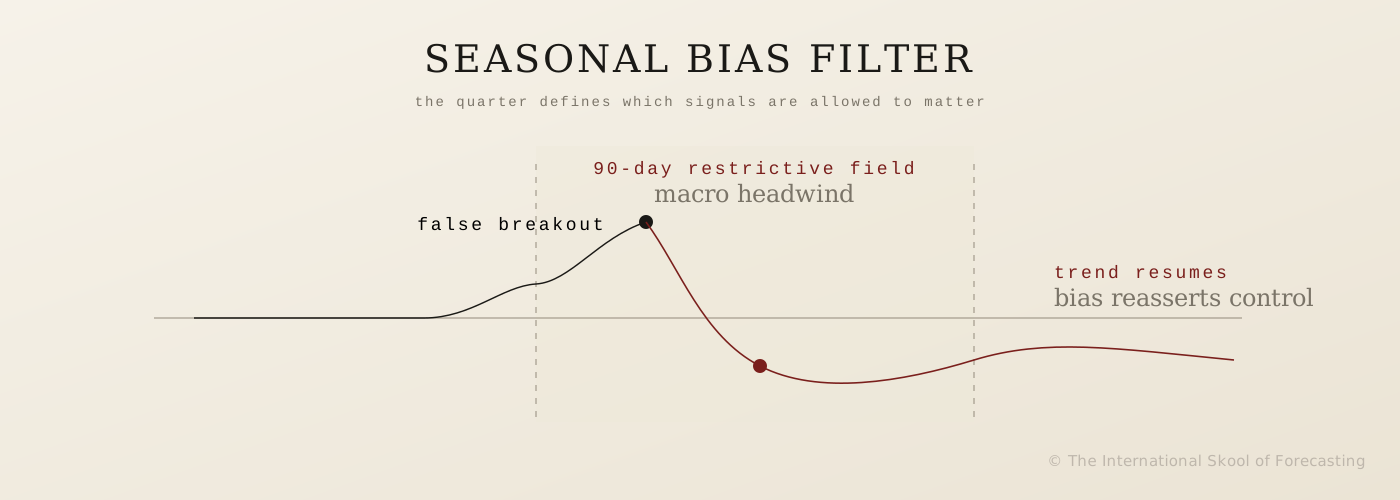
If the Ingress chart indicates a heavy, restrictive quarter dominated by Saturn, the Seasonal Bias is bearish. A professional Forecaster operating under this bias will ignore bullish daily chart breakouts during this 90-day window. Why? Because those breakouts are swimming against the macro tide. They are false signals generated by retail enthusiasm that lacks institutional backing.
5. Refusal and Inversion at the Gates
What happens when the market refuses to obey the gate? If the Ingress chart projects a bearish quarter, but the market grinds aggressively higher through the solstice, the amateur assumes the method is broken. The professional knows they have just been handed the most valuable signal in forecasting: The Refusal.
If the market is strong enough to rally in the face of restrictive seasonal time pressure, the underlying bid is immensely powerful. It is like a boat accelerating directly into a gale-force wind. When the seasonal pressure finally shifts to support the trend in the next quarter, the market will experience a parabolic markup. By observing how price behaves as it crosses the gate, the Forecaster calibrates the true, hidden strength of the market.
6. The Pathways
The mathematics required to accurately cast, weight, and interpret an Ingress chart — including the specific calculation of mundane planetary aspects during the grave of winter — are highly proprietary. The detailed rules for reading these gates and applying them to modern market geometry are taught exclusively in our advanced curriculum, Time by Solar Degrees.
For those who wish to see the current Seasonal Bias applied in real-time to the S&P 500, Gold, and Bitcoin without executing the complex calculations themselves, follow the quarterly Ingress reports published in The Forecaster. These reports provide the clinical, 90-day macro filter required to trade with the tide, rather than against it.
← Back to the library