William Gann studied celestial mechanics and price cycles in New York at the turn of the twentieth century. Louise McWhirter studied the lunar node and the New York Stock Exchange in the 1930s. Samuel Benner studied pig iron prices on a farm in Ohio in the 1870s. Walter Gorn Old — writing as Sepharial — studied planetary orbits and world history in London at the end of the Victorian era.
None of them taught the same system. All of them taught that the market follows a law, not a random walk. Their methods are distinct. Their conclusion is the same.
The International Skool of Forecasting uses all four. Not as historical decoration. As the working framework.
W.D. Gann — The Architect of Time and Price.
Gann believed that markets repeat because the forces driving human behaviour are cyclical. His name for this was the Law of Vibration — the proposition that price and time are both expressions of a single underlying frequency, and that by measuring one you can calculate the other.
His most documented proof came in 1909. Under conditions arranged by financial journalist Richard Wyckoff, Gann executed 286 trades across 25 market days. Of those, 264 were profitable. Wyckoff published the account. It remains one of the few independently verified track records in the history of market forecasting.
Gann’s primary working cycle was the Jupiter-Saturn conjunction — a 20-year astronomical rhythm he observed aligning consistently with major market turning points. The modern record confirms it: 1929, 1949, 1966, 1987, 2009. Each represents a significant high or structural reversal. Each falls near a Jupiter-Saturn conjunction or opposition. The 60-year cycle — three 20-year periods — marks the larger generational turning points.
His other primary tool was the Square of 9. Not a geometric shape but a mathematical spiral that converts price into time and back. A known price level fed into the spiral produces the next significant harmonic support or resistance. This is the tool that produced the 2022 gold call: $1,621 calculated from the 90-degree angle. The actual low was $1,620.32.
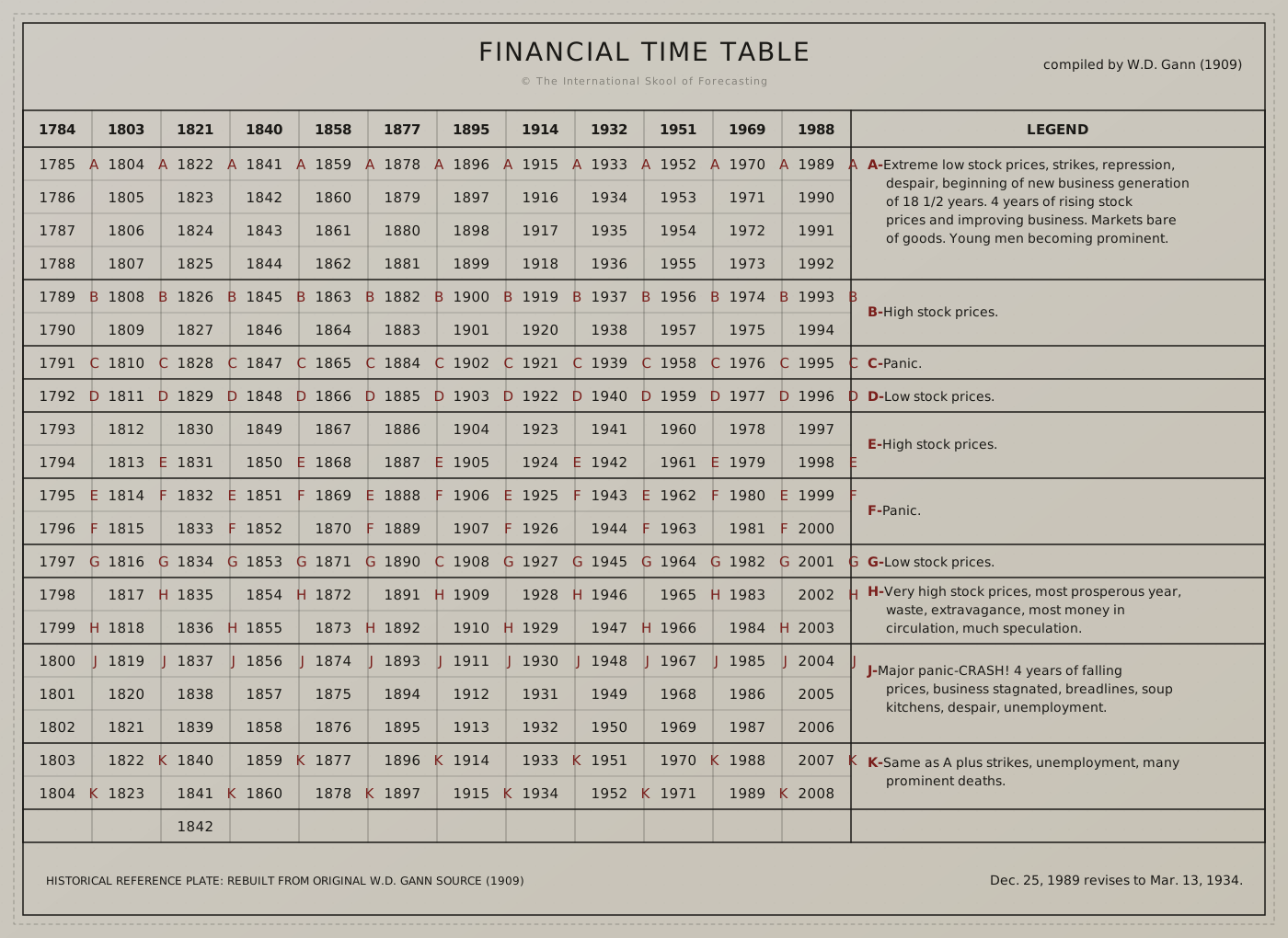
Gann used anniversary cycles — 10, 20, 30, 60 years — to identify turning point clusters years in advance. The 1929 forecast, overlaid on the actual Dow Jones chart, shows the method in practice.
“Time is the most important factor of all — because when time is up, price will reverse.”
Applied directly: the 2022 gold call was generated by time calculation, not price forecasting. The two-decimal confirmation was not coincidence. It was the Square of 9.
Louise McWhirter — The Lunar Business Cycle.
McWhirter worked in New York during the Depression. Her question was not philosophical. The collapse of 1929 had just destroyed fortunes. She wanted to know if it could have been anticipated — and whether the next one could be.
Her answer was yes. The mechanism was the Moon’s North Node.
The North Node takes 18.6 years to complete a full cycle through the zodiac. McWhirter mapped this cycle against 100 years of NYSE data and found a consistent, measurable relationship between the node’s zodiacal position and the general level of business activity. She published her findings in 1938 in McWhirter Theory of Stock Market Forecasting.
The warm zone: as the node moves through Scorpio, Libra, Virgo, Leo, and Cancer, business activity tends to expand. Credit flows. Sentiment rises.
The cold zone: as the node descends through Aquarius, Capricorn, Sagittarius, and Pisces, business activity contracts. Credit tightens. Sentiment deteriorates.
This is not astrology in the popular sense. It is a documented correlation between a measurable 18.6-year rhythm and economic behaviour, tested across a century of data. McWhirter herself published accuracy rates of approximately 70% on direction calls derived from the node position. The remaining 30% were what she called polarity flips — periods where the market inverted the cycle’s expected behaviour. She documented when these flips were likely and why. The 2023 S&P 500 rally, against every bearish cycle signal, is a recent example.
The North Node entered Aries in late 2023. It moves into Pisces — deep cold zone — in early 2025. This is the background weather for the 2026 window.

The node’s descent through the cold zone (Aquarius through Pisces) has historically corresponded with recessions, credit contractions, and equity bear markets. The current descent begins 2025.
Samuel Benner — The Farmer Who Called the Panics.
Benner was an Ohio farmer. The panic of 1873 destroyed him financially. He spent the remainder of his life trying to understand why.
What he found was in pig iron prices. Pig iron is a commodity stripped of sentiment — its price reflects only supply, demand, and the underlying rhythm of industrial activity. When Benner charted pig iron across several decades, he saw a pattern. High prices and low prices alternated on a sequence of 16, 18, and 20-year intervals. The sequence was not random. It repeated.
He published his findings in 1875: Benner’s Prophecies of Future Ups and Downs in Prices. In it, he forecast specific years of high prices and specific years of panic through to 1920. He was writing in 1875. Several of his forecasts — including the panics of 1891 and 1907 — proved accurate to the year.
Benner’s contribution to the framework is the identification of alternating pressure. His A-B-C phase cycle shows that prosperity and panic follow each other in a predictable sequence, not randomly. The years change across cycles. The structure does not.
His 54-year major cycle — two full 27-year sequences — marks the years of maximum overvaluation. It lists 2026 as a year of peak overvaluation and optimal exit conditions. He wrote this cadence in 1875. It is still in the sequence.
High-price years: 1882, 1891, 1902, 1910, 1920 — following the 8-9-10-year alternation.
The 1882 high and the 1891 low were confirmed by the historical record. The 54-year extension places 2026 directly in the same phase as 1972 — the year before the 1973 oil shock and the deepest US recession since 1929.
Sepharial — The World Horoscope.
Walter Gorn Old wrote under the name Sepharial. He published more than forty books, including Economic Astrology, The Law of Values, and A Manual of Occultism. He worked at the end of the Victorian era, when the investigation of natural cycles was still considered a legitimate scientific pursuit.
Sepharial’s contribution is scale. Where Gann focused on individual stocks and commodities and McWhirter on business cycles, Sepharial mapped nations. His World Horoscope assigned planetary rulerships to countries, commodities, and industries based on historical correlations between celestial events and economic turning points.
Saturn rules gold. Jupiter rules equities and credit expansion. Mars rules energy, military spending, and industrial raw materials. Mercury rules communications and transportation. These are not metaphors. They are empirical associations drawn from 400 years of recorded economic history and the planetary positions at the times of major events.
The 36-year cycle — three full Jupiter orbits, one Saturn-Uranus arc — governs which planetary energy dominates the economy for a generation. Each 36-year period has a signature: the type of growth that occurs, the type of authority that governs it, the type of failure it eventually produces.
The current period runs from 2017 to 2053. Saturn in Aries. Rapid expansion of structures built under emergency conditions, authority without institutional depth, repeated cycles of crisis management. This is the context in which the other three systems’ cycles are currently operating.
The Power of Confluence.
Each system is useful on its own. Together they are a different category of tool.
When four independent cycle frameworks — developed across sixty years, in four countries, by researchers who never compared notes — point to the same narrow window, the probability of that window being significant is not the sum of the parts. It is considerably higher.
The 2022 gold call demonstrates this in practice. Gann’s Square of 9 calculated $1,621 as The Harmonic Price Anchor. McWhirter’s node cycle indicated bearish pressure through Q3 2022. Benner’s minor cycle pointed to a September turning point. Three independent systems. One conclusion. The actual low: $1,620.32 in September 2022.
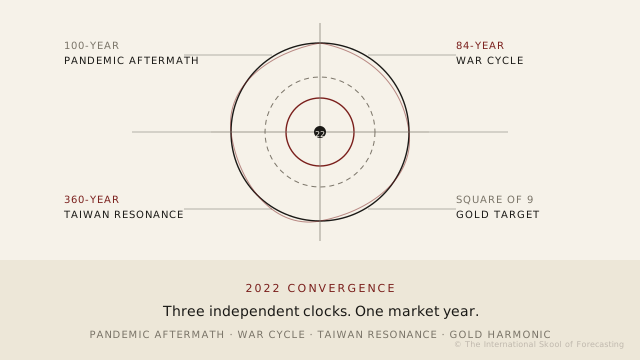
No single system produced the $1,621 target alone. The agreement between three independent frameworks is what made the call viable. This is the principle the annual roadmap is built on.
The 2026 window is a larger version of the same phenomenon. The 60-year master cycle, the 18.6-year node expiry, the 40-year earth cycle, and Benner’s 54-year overvaluation marker all point to the same narrow period. Not because they are the same system. Because the underlying reality they are each measuring is the same.
Summary of the Four Traditions.
| Researcher | Primary Cycle | Focus | Key Contribution |
|---|---|---|---|
| W.D. Gann | 20-year / 60-year | Time & Price | Mathematical harmony between price levels and time intervals. Square of 9. |
| L. McWhirter | 18.6-year Node | Business Sentiment | Warm and cold zones mapped to zodiacal node position. Documented ~70% accuracy. |
| S. Benner | 54-year / 16-18-20 | Economic Seasons | Alternating panic and prosperity sequence. Specific year predictions from 1875. |
| Sepharial | 36-year / 432-year | World Horoscope | Planetary rulerships of nations and commodities. Generational economic context. |
Where to begin your study.
Start with McWhirter. Her 18.6-year cycle is the most directly verifiable — the historical data is public, the methodology is documented, and the current position of the North Node is easily confirmed. Once that background is established, Gann’s timing tools and Benner’s phase sequence read more clearly in context.
The 18.6-year tide essay goes deeper on McWhirter’s cycle and its current position. The applied annual research — where all four systems run in parallel against live markets — is inside the annual membership.