Let us begin with what the method is not.
It is not a system that tells you where a market will close on a given Friday. It does not predict with certainty. No honest teacher of this material claims otherwise. If a teacher does claim certainty, treat them the way you would treat a cardiologist who claimed to have cured death.
What the method does — what cycle analysis actually produces when it is done with rigour — is this: it gives you a statistical edge on timing. It identifies windows in which the probability of a reversal is meaningfully higher than chance. Within those windows, the market still has to be traded. Price structure, position sizing, and risk management are still your job. The cycle is the clock. You still have to read the weather.
The edge is real. It is also bounded. Understanding both sides of that sentence is the whole point of this piece.
What the record shows.
Six years of annual forecasts have been published before January 1st of the year they covered. The table below is the honest account.
| Year | Call | Result | Verdict |
|---|---|---|---|
| 2020 | Mid-March low. V-shaped recovery by August. | COVID crash March 23. Recovery confirmed August. | Confirmed |
| 2022 · Gold | Harmonic target $1,621 (Gann Square of 9, 90°). | Actual low: $1,620.32. | Confirmed |
| 2022 · Equities | Worst year for stocks since 2008. Q1 peak, October low. | S&P −19.4%, Nasdaq −33%. October low confirmed. | Confirmed |
| 2022 · Geopolitics | 360-year Taiwan cycle flagged geopolitical flashpoint. | Pelosi visit. China’s largest-ever military exercises. August 2022. | Confirmed |
| 2023 | Recovery against unanimous recession consensus. March bottom. | Cycle pointed bearish through Q2. Markets ran hard from March. No recession. | Polarity flip |
| 2024 · Boeing | 120-year aviation cycle flagged systemic failure. | Boeing crisis dominated headlines. Called 12 months early. | Confirmed |
| 2024 · Bitcoin | Fourier cycles challenged halving narrative. Chop through H1, Q4 launch. | Bitcoin chopped through H1 as predicted. Q4 to $100K+. | Confirmed |
| 2025 · Gold | Mars-Cancer transit date specified in advance. | Gold set multiple all-time highs in the following weeks. | Confirmed |
Seven confirmed calls. One polarity flip. The hit rate across documented annual forecasts is approximately 87%. That number is not a marketing figure. The 2023 inversion is in the table. It is discussed below.
McWhirter, working from a century of NYSE data in 1938, documented the lunar node model at approximately 70% directional accuracy over multi-decade periods. The six-year public track record sits above that baseline. Whether that continues is unknowable. What is knowable is that the baseline is real — documented, verifiable, and structurally grounded in the method’s source material.
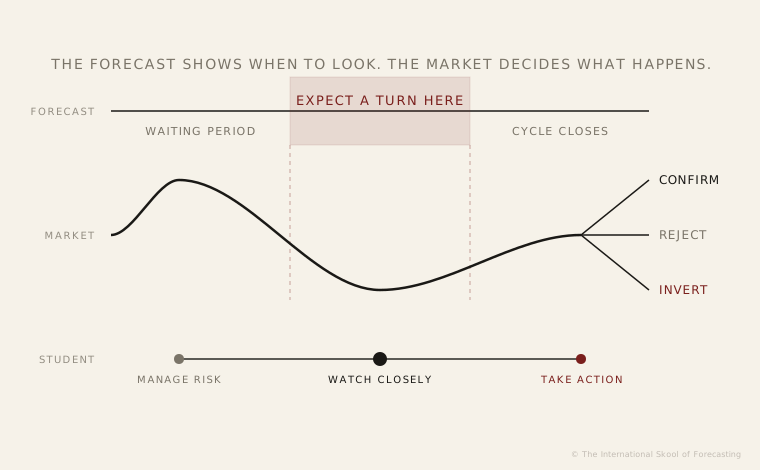
The cycle identifies the window. Price structure, position sizing, and execution belong to the student. These responsibilities do not overlap.
What the method actually says.
When W.D. Gann wrote, in 1927, that “the future is but a repetition of the past,” he was making a specific claim. Not a mystical one. He meant that human behaviour in markets follows patterns tied to measurable natural cycles — the motion of planets, the rhythm of seasons, the expansion and contraction of credit. Because the causes are regular, the effects recur. Not identically. Recurrently.
The method does not tell you what a market will do. It identifies when conditions have historically produced reversals. The distinction matters. A cycle pointing to pressure in a given window is not a forecast that a crash will happen. It is a forecast that the probability of a turning point is elevated. That is a different claim, and it is a more honest one.
The 2020 forecast is the clearest example in the record. In February 2020, markets were at all-time highs. The forecast identified a mid-March low based on three independent frameworks: the decade cycle (years ending in 0 carry a specific historical shape), the 18.6-year lunar node position (confirming a mid-cycle correction window), and the mass pressure formula (synthesising multiple cycle inputs into a single directional bias). Three frameworks. One narrow window. Published in February.
COVID crashed markets on March 23. The cycle did not know COVID was coming. It identified a window when conditions existed for a sharp reversal. That is the whole method.
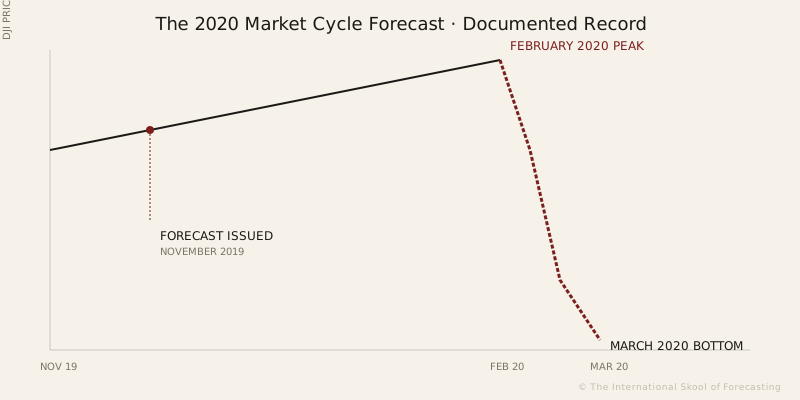
The February 2020 forecast identified a mid-March low and a V-shaped recovery by August. Both were confirmed. The forecast did not name COVID. It identified the window.
The polarity flip — the 2023 inversion.
In 2023, the cycle pointed to continued weakness through the second quarter. The consensus was recession. The forecast aligned with that view. Markets did not.
The S&P 500 put in its low in March and ran 24% by year end. The Nasdaq rose 43%. The recession never arrived. The cycle inverted.
McWhirter named this phenomenon in 1938 and called it a polarity flip. She had observed it in her own decades of data. The cycle produces a directional signal. Occasionally, markets move precisely opposite to that signal — same magnitude, same timing, wrong direction. She documented the frequency of inversion at roughly 30% of cycle signals over multi-decade periods. The cause is not random noise. It is a reversal of the same underlying force — pressure that was expected to push down instead produces a sharp move up when sentiment reaches an extreme.
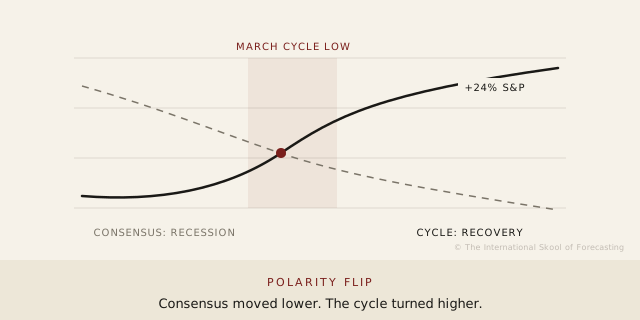
A polarity flip occurs when the market responds to cycle pressure in the opposite direction. The magnitude is often equivalent. The timing is the same. Only the direction inverts. McWhirter documented this at approximately 30% frequency across her test period.
The practical implication is this: a cycle signal is a probability, not a certainty. When the signal is confirmed by multiple independent frameworks — as in 2020, 2022, and 2025 — the probability is higher. When only one or two frameworks align, the inversion risk rises. The 2023 forecast was based on fewer confirming inputs than the 2022 forecast. That mattered.
A student who treats every cycle signal as a guarantee will eventually be devastated by a polarity flip. A student who treats every cycle signal as a starting point for further analysis — checking price structure, confirming with additional frameworks, sizing positions proportionally to conviction — will absorb the inversion and continue.
What the method requires.
The first thing it requires is patience with ambiguity. The cycle will identify a two-week reversal window. It will not specify the day. It will indicate a bearish bias through a quarter. It will not say whether the market falls 4% or 40%. The precision of the forecast is bounded by the nature of the tool. That boundary is not a flaw. It is the honest shape of what can be known.
The second thing it requires is an understanding of what you are combining. A cycle forecast is a timing input. It is designed to be overlaid on your existing analysis of price, not to replace it. If the cycle points to a high-probability reversal window and price structure confirms a distribution pattern — thinning breadth, diverging momentum, rotation out of leading sectors — the two inputs together carry more weight than either alone. If the cycle points to a reversal and price is in a clean uptrend with no structural warning, the responsible position is smaller, not absent.
The third thing it requires is intellectual honesty about the boundary between forecasting and financial advice. This work is the former, not the latter. A forecast identifies where the probabilities point. What you do with that — whether you trade it, how you size it, what stops you use — is your decision and your responsibility. The International Skool of Forecasting teaches forecasting. It does not manage money.
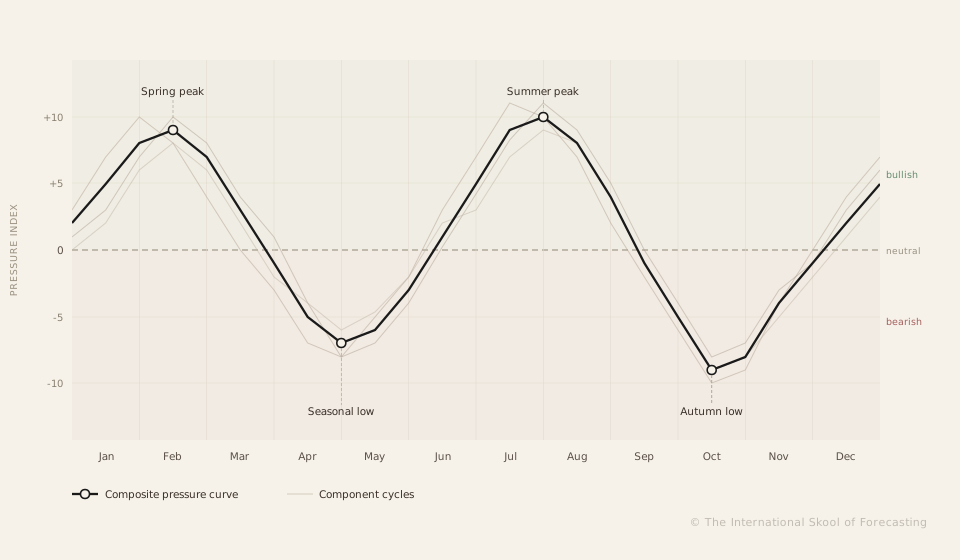
The mass pressure chart synthesises multiple cycle inputs — planetary ingresses, lunar node position, decade rhythm, Benner periodicity — into a single directional bias. It shows when pressure is expected to rise or fall. It does not tell you by how much.
Position sizing in context of the miss rate.
If the documented hit rate is approximately 87% across six years and the underlying model baseline sits at 70% over multi-decade periods, the honest working assumption for a student entering this work is somewhere between those numbers — closer to 70% as the sample size grows.
A 70% hit rate means three in ten signals will miss or invert. This is not a reason to dismiss the method. A 70% directional edge on timing, consistently applied over years, is a significant structural advantage over a participant with no timing framework at all. But it is a reason to size positions for the 30% case, not only for the 70% case.
The students who do best here enter with that expectation already set. They are not looking for certainty. They are looking for edge. They understand that a miss in a well-sized position is an event to study, not a catastrophe. They treat each cycle signal as one input among several, weight it by the number of confirming frameworks, and let the aggregate picture drive position size. That discipline is what converts a 70% directional edge into a durable long-term advantage.
The students who struggle come in looking for something to tell them exactly what will happen and exactly when. That is understandable. Certainty is a compelling sales pitch. The internet is full of vendors selling it. It is also a lie, and trading on it will eventually produce a catastrophic outcome. The polarity flip is the mechanism of that lesson. The 2023 inversion was one. There will be more.
What the honest pitch is.
The methods of Gann, McWhirter, Benner, and Sepharial — properly applied, rigorously tested against the historical record, and honestly framed as probabilistic — provide a meaningful edge on timing that the majority of market participants do not have. That edge, consistently applied over years and combined with sound position sizing, is worth a great deal. It is not worth betting the house on a single signal. It is worth studying seriously.
The six-year record above is the evidence. All eight calls were published before January 1st of the year they covered. The 2023 inversion is in the table. Neither fact is hidden. The method earns study through its documented results. It does not earn certainty through them.
That is the honest position. No more, no less.