Most approaches to Gann start with the tools. People find the angles, the squares, the famous price levels — and they apply them like a technical system. When the results disappoint, they conclude that Gann was fraud or folklore. They are usually wrong. The tools are not the problem. What is missing is the theory that gives the tools their meaning.
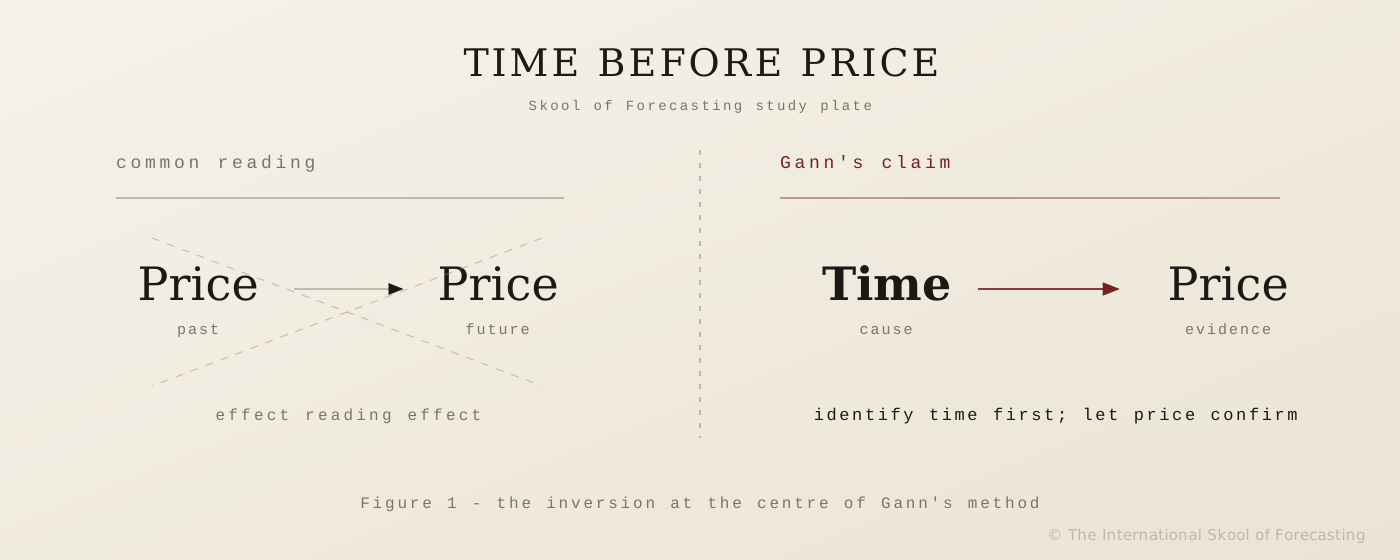
Gann built his method on one specific and testable claim: that markets are governed by Time, not Price. Price is the evidence. Time is the cause. This is not a philosophy. It is the operating principle of everything he built, and it is the reason most people who study his work in pieces never fully understand what they are holding.
The claim at the centre of the method.
In most market analysis, price is both the input and the output. You study where price was in order to estimate where it is going. Gann rejected this entirely. He argued that looking at price to predict price is like watching a shadow to understand the object casting it. The shadow is real. But the cause is somewhere else.
His claim was that Time — structured, mathematical, cyclical Time — precedes every significant market move. A top does not form because sellers happen to outnumber buyers on a given day. It forms because the time for a top has arrived, and the accumulated weight of historical pressure has reached a turning point. The buyers and sellers are responding to that pressure. They are not creating it.
If this is correct, then the entire premise of conventional analysis is inverted. You do not study where price has been. You study when the next window of pressure is due to arrive — and then you wait for price to confirm it.
The Law of Vibration.
In 1909, a journalist from the Ticker and Investment Digest spent time with W.D. Gann observing his method in practice. The resulting interview is the closest thing we have to a first-hand account of how Gann understood his own work. He said this:
“By my method I can determine the vibration of each stock, and by also taking certain time values into consideration I can in the majority of cases tell exactly what the stock will do under given conditions.”
The word vibration has caused more confusion about Gann than almost anything else. It sounds mystical. It is not. What Gann meant was specific: every market has a measurable rate of movement. That rate — its frequency — determines how fast it cycles, how deep its corrections tend to be, and at what intervals it is likely to turn. It is a property of the market itself, derived from its history, and it can be calculated.
Two markets moving through the same calendar year are not in the same cycle position. One may be in the third year of a major advance. Another may be approaching the end of a decade-long correction. Their “vibrations” are different. A forecasting method that ignores this and applies the same timing rules to both will be wrong more often than right.
The Law of Vibration is not a tool. It is the reason the tools exist. Before you can apply an angle, a square, or a cycle, you need to know the vibration of the market you are studying. This is the work that comes before everything else, and it is the work that most people skip entirely.
The hierarchy problem.
There is an old Indian story about six blind men asked to describe an elephant. Each one touches a different part. The man who finds the leg says it is a pillar. The man who finds the tail says it is a rope. The man who finds the ear says it is a fan. All six are right about what they are touching. All six are wrong about what it is.
This is exactly what happens when an analyst takes a single Gann cycle and applies it in isolation. They are holding something real. But without the surrounding structure, they cannot know what they are holding.
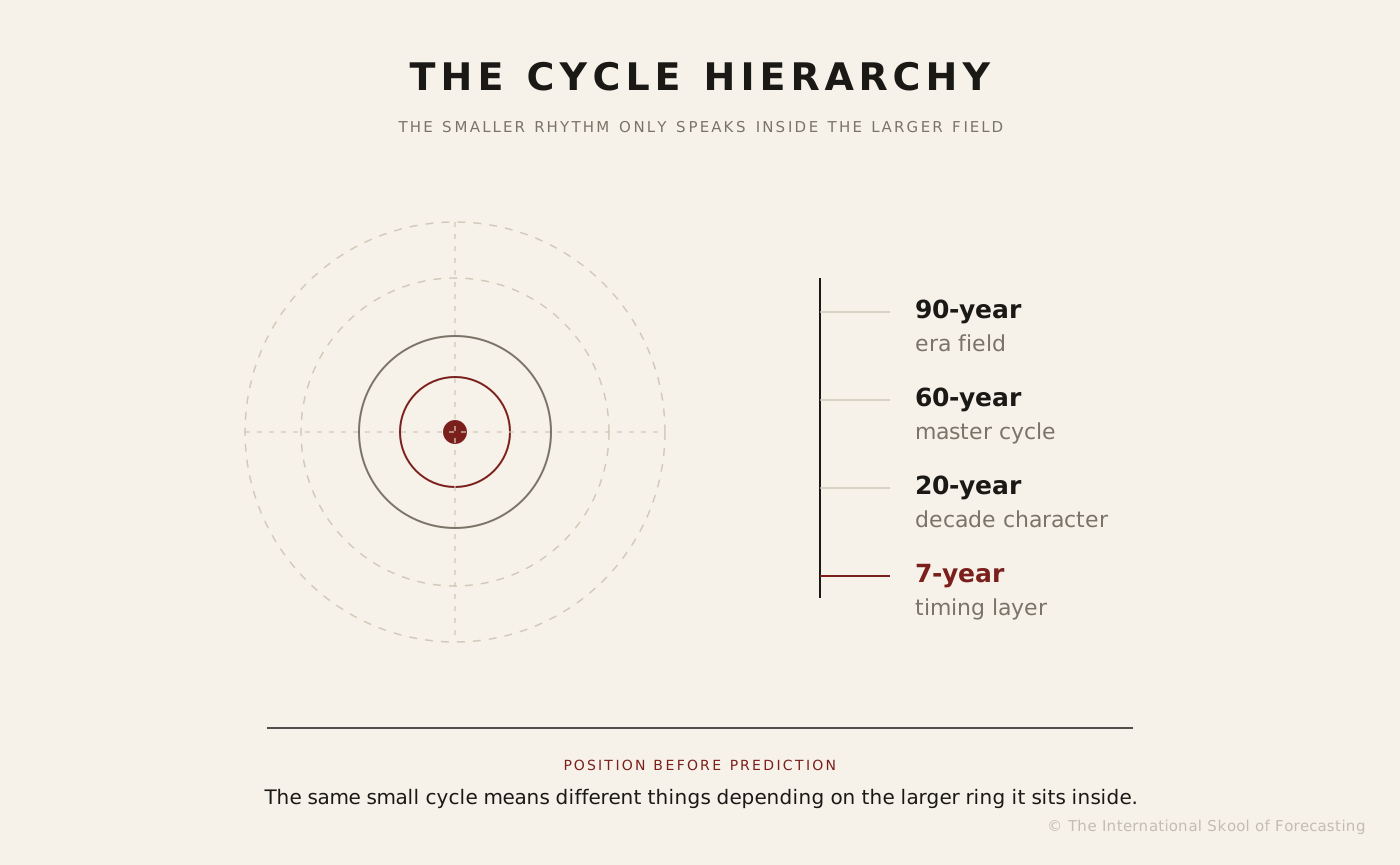
Gann’s method operates through a hierarchy of cycles. The largest ones — 90 years, 60 years — define the character of an era. The medium ones — 20 years, 7 years — define the character of a decade. The smaller ones narrow the timing down to the month, the week, the window. Each inner ring only carries meaning when you know which part of the outer ring you are standing in.
A 7-year cycle low inside a 60-year bull phase is a buying opportunity. The same 7-year low inside a 90-year contraction may be a temporary floor before a much larger decline continues. The cycle measurement is identical. The meaning is entirely different. Position in the hierarchy determines everything.
Gann’s Financial Time Table, compiled in 1909, was his attempt to map the outer rings in a form that could be applied year by year. It projects periods of expansion, contraction, panic, and recovery decades into the future — not as a trading signal, but as a positioning document. It tells you where you are in the large structure before you do anything else. This is where serious forecasting begins.
Cycles and periodicity are not the same thing.
Most people who study market cycles think that periodicity is just another word for the same concept. It is not. This distinction is one of the least discussed aspects of Gann’s work — and one of the most important.
A cycle is a wavelength. It tells you how long a pattern takes to complete. Periodicity is the sequencing of how multiple cycles interact over time. The difference is similar to the difference between knowing the size of two gears and knowing when their teeth actually mesh. Two gears of different sizes may engage smoothly at some intervals and poorly at others. The size of the gear is not the event. The meshing is the event.
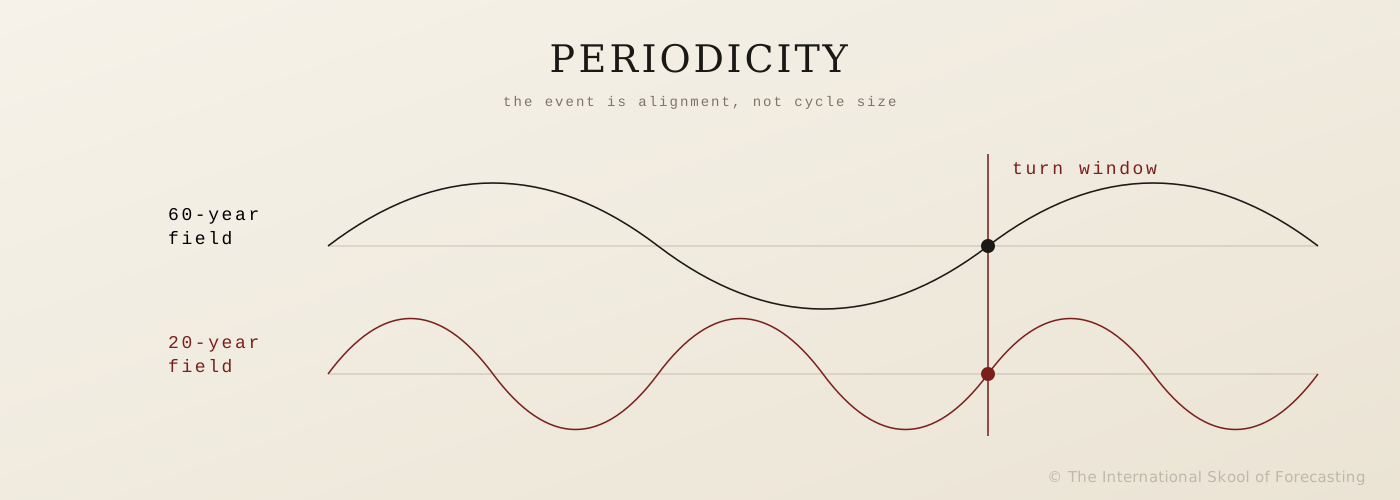
Gann said that “history repeats itself.” Most people take this to mean that cycles recur. What he was pointing at was something more precise: that the sequencing of those recurrences follows a mathematical logic that can be worked out in advance. When you understand the sequencing — not just the individual cycle lengths — you can identify the specific intervals where the weight of history is most concentrated. Those are the high-confidence turning windows. Everything else is noise waiting for its turn.
The time factor Gann called his greatest discovery.
In his novel The Tunnel Thru the Air, published in 1927, Gann’s central character makes what the text describes as “a new and great discovery of a time factor.” The character uses it to forecast a major market move more than two years in advance, specifying the month, the direction, and the approximate extent of the move.
Gann was known for encoding his most important discoveries in plain sight — placed inside fiction, buried in the language of his courses, or hidden in the structure of his charts. This particular clue is one of the clearest he ever left. The time factor he was describing is an 18.6-year astronomical cycle. It was the basis of his Financial Time Table — the same positioning document mentioned above — and it was, in Ferrera’s research, the central organising principle behind Gann’s most accurate long-range forecasts.
Gann compiled his Financial Time Table in 1909. It projected economic conditions — high stock prices, panics, recessions, speculation — decade by decade into the future. Checking that table against what actually happened across the 20th century is a useful exercise. The results are not perfect. They are, however, consistently better than chance, and in several cases strikingly precise. The 2000 high, the 2007 panic, the 2009 low — all appear in the structure of a table built a hundred years before they occurred.
The time factor itself is not difficult to name. What is difficult is knowing how to use it correctly — how to weight it against the larger cycle hierarchy, how to identify its trigger points within a given year, and how to read it in combination with the other cycle layers that determine whether a signal is high-confidence or marginal. That is the private work of the Forecaster, and it is not available in any public Gann text.
Where this leads.
Gann said: “In order to know and predict the future of anything, you only have to look up what has happened in the past and get a correct base or starting point.” The base is the large cycle structure. The starting point is knowing exactly where inside it you currently stand.
This article gives you the framework for that understanding: Time before Price, the Law of Vibration, the cycle hierarchy, the distinction between cycles and periodicity, and the existence of a time factor that Gann considered his most important discovery. None of this is the method. It is the context that makes the method legible.
The method itself has three layers of study. The first is understanding the macro cycle structure and how to position yourself within it — that is the work of Financial Time Table. The second is learning how to construct cycle composites from those active layers — that is the work of Wheels Within Wheels. The third is seeing the method applied to the live market, month by month — that is The Forecaster.
The theory is here. The method is inside the courses. Each one teaches a distinct layer of the system, in the order Gann intended them to be learned.