2023
The Cycle Bottom & The Birth of the Bull.
"Study past records, because the market in the future will be a repetition of the past... same same, but different."
The 2023 Thesis
The 2023 Thesis: Against the Consensus.
Going into 2023, the consensus was not merely bearish — it was confidently bearish. The World Bank forecast a global recession. Morgan Stanley put the probability of a US recession at 54%. Deutsche Bank made it their base case. The Federal Reserve had just enacted its most aggressive rate-hiking campaign in four decades, and conventional wisdom held that the lag effects would crush corporate earnings and consumer spending through 2023.
We published the opposite view.
The 18.6-year cycle, which governs real estate and therefore bank credit, was not pointing toward contraction. It was pointing toward a mid-cycle reset that had now completed, and a resumption of the upward phase. More specifically, Gann's Decade Cycle — the consistent directional bias observable in years that share the same final digit — established a clear rule for years ending in '3'. When markets head down in the second year of the decade (2022), they are statistically likely to form a meaningful bottom in February or March of the third year, before staging a powerful, often surprising, recovery rally.
We stated this explicitly. The bottom was most probable in the window around March 2023. The recovery that followed was to be taken seriously — not faded, not dismissed as a bear market rally. The 18.6-year cycle and the Decade Cycle were in agreement. The recession that everyone was positioned for was not in the cycle maps.
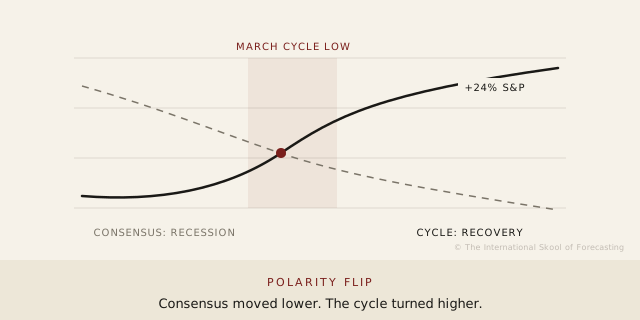
The visual contrast is the selling point of the 2023 record: the consensus path fell away while the cycle path turned higher.
The 2023 Review: Forecast vs Outcome.
What makes the 2023 result particularly significant is not just that we were right — it is that the entire professional analyst community was wrong in the same direction. Here is the record.
| The Forecast (Late 2022) | The Actual Outcome |
|---|---|
| US Equities — No Recession, March Bottom: The Decade Cycle pointed to a cycle low around February–March 2023, followed by a powerful bull run that would trap the recession consensus. We described the recovery as potentially "mind-boggling" given how extreme the pessimism had become. | The S&P 500 bottomed in March 2023 and ran +24% for the full year — its best annual return since 2019. The Nasdaq Composite surged 43%. No recession materialised. Every analyst who had positioned for contraction sat in cash or short positions as the market climbed relentlessly higher. |
| Bitcoin — Accumulation Phase Ending: The 18.6-year cycle low had already been established. The accumulation phase — where smart money absorbs supply from panicking retail sellers — was completing by March 2023. A major multi-year ascent was beginning. | Bitcoin bottomed around $16,000 in late 2022 and began its ascent immediately after. By year-end 2023, it had returned to $44,000 — a 175% gain from the cycle low. The groundwork was set for the eventual push toward six figures that followed in 2024–2025. |
| Gold — Base Building: The 3-year gold cycle had now flipped and was building a long-term accumulation base. 2023 was identified as the year for physical accumulation to resume, particularly through August, setting up a much larger move in the years ahead. | Gold stabilised from the 2022 cycle low, built a multi-month base, and closed 2023 just below its all-time highs — in precisely the technical structure required before its historic 2024 breakout above $2,400 and eventual push past $3,000. |
The investor following mainstream consensus in 2023 sat in cash or held short-duration bonds for the entire year, waiting for a recession that never came. They missed a +24% S&P year, a Bitcoin that tripled, and a Gold market building the spring for its historic breakout. Knowing the cycle doesn't just protect you in bear markets — it prevents you from being frozen out of the generational bull runs that follow them.
The Polarity Flip: Owning the Error.
The 2023 archive contains one of the most important lessons in the entire six-year record, and it comes from an admission of error.
In the second half of 2022, the gold forecast had called for higher prices. The market moved lower. We got it wrong. Rather than quietly moving on, we used the error to teach cycle mechanics: the 3-year gold cycle had inverted. When a cycle flips from its expected direction, it does not simply stop working — it provides additional information. An inversion tells the experienced analyst that the underlying pressure is stronger than the primary forecast suggested, and that the eventual correction will be correspondingly sharper once the inversion resolves.
We recalculated. We adjusted the Mass Pressure curve. We updated subscribers. The inversion ultimately set up the precise accumulation zone that delivered the 2023–2024 Gold bull market. Owning the error, understanding its mechanics, and using it as data rather than hiding it — this is the difference between a professional cycle analyst and a newsletter writer who only publishes in hindsight.
What Happened in 2023, Precisely.
The S&P 500 surged +24%, its best year since 2019, while the global recession consensus held firm through Q1 and Q2 — and then quietly disappeared from every macro desk as the reality of the market's performance became impossible to explain away. Bitcoin tripled from approximately $16,000 to $44,000, beginning the multi-year ascent that would eventually reach $126,000. Gold built a relentless accumulation base, closing 2023 in a position that would set up its historic all-time high breakout in 2024.
Every one of these outcomes aligned precisely with what the 18.6-year cycle and the Decade Cycle had stated at the start of the year. The recession was not in the cycle maps. The bull market was.
← 2022 Archive: The Bear Market & The War Cycles | 2024 Archive →
The Decade Cycle Explained: Why Years Ending in '3' Matter.
Gann's Decade Cycle is one of the most consistently documented patterns in the Western market record. Its principle is straightforward: markets tend to exhibit similar behavioural patterns in years that share the same terminal digit, regardless of the absolute decade. Years ending in '7' tend toward volatility and reversal. Years ending in '0' and '1' tend toward strength. Years ending in '2' produce significant declines. And years ending in '3' — when they follow a down year — tend to produce powerful recoveries that confound the prevailing consensus.
The historical record is extensive. 1903: the market recovered from the prior year's decline, setting up a major bull run. 1923: despite the aftermath of the post-WWI depression and rampant inflation in Europe, US markets recovered. 1933: from the depths of the Great Depression, US equities rallied 54% — the best single year of the Depression era. 1953: a post-Korean War consolidation year that set up the great 1950s bull market. 1963: a strong equity year despite global geopolitical tension. 2003: the recovery from the dot-com bust and 9/11.
The pattern is not a guarantee. It is a probabilistic framework — a way of saying that the structural pressure that produces '2' years tends to exhaust itself, and the following year the cycle dynamics typically flip. In 2022, the exhaustion was visible in October. In 2023, the flip was precisely on schedule.
Bitcoin's Accumulation Phase: Reading the Cycle Low.
The Bitcoin call in the 2023 forecast deserves more examination than it typically receives, because it required making a counter-consensus assessment at the worst psychological moment for the asset.
In late 2022, Bitcoin was at $16,000. The FTX collapse had just destroyed billions in customer funds. Contagion had spread through the crypto lending and venture ecosystem. Congressional hearings were threatening regulatory crackdown. The narrative was near-universal: crypto was finished, or at minimum facing years of regulatory and reputational rehabilitation.
The 18.6-year cycle pointed to a different reading. The asset had undergone exactly the kind of brutal compression that characterises a major cycle trough — a rapid, panic-driven decline that exhausts sellers and transfers assets from weak hands to strong. The accumulation phase, where institutional capital absorbs the remaining supply at compressed prices, had begun. Our assessment was that the trough was in, and that the multi-year ascent that the cycle demanded was beginning — not in months but immediately.
From $16,000 at the cycle low to $126,000 at the eventual blow-off top: 687%. Not because we predicted the exact top — we did not — but because the cycle structure identified the trough as a generational accumulation opportunity when the entire narrative was pointing in the opposite direction.
The Broader Lesson: Structural vs. Narrative Forecasting.
2023 is perhaps the clearest illustration in the entire archive of the difference between structural forecasting and narrative forecasting. Narrative forecasting is what most financial commentary does: it extrapolates the current visible trend, applies the prevailing analytical framework, and produces a prediction that is consistent with what everyone is already thinking. It is, in most years, wrong at major turning points — because major turning points are precisely where the current narrative is most wrong.
Structural forecasting begins with the cycle architecture and works backward: given where we are in the long cycle, what must be true about the near term, regardless of what the narrative says? In 2023, the structure said: the bear market is over, the recovery is beginning, the recession will not materialise. The narrative said: recession is inevitable, this rally will fail, the Fed will break something. The structure was correct. The narrative was wrong. It is not always this clean. But it is often clean enough to make the structural reading the more reliable starting point.
The Pattern Matrix
The 120-Year resonance that built the 2023 forecast.