Library
The McWhirter Method — how lunar cycles forecast market direction.
McWhirter's method is a structural forecasting tool. It measures systemic vulnerability before price movement occurs.
Louise McWhirter published Astrology and Stock Market Forecasting in 1938. The global economy was still processing the structural damage of the Great Depression. Conventional economic analysis had failed to predict the 1929 crash. It also failed to predict the subsequent multi-year contraction. McWhirter bypassed fundamental data entirely. She sought a leading indicator that could not be manipulated by central banks or corporate accounting.
She found that indicator in planetary mechanics.
McWhirter observed that the business cycle is a measurable expression of collective human psychology. Markets expand when capital allocators feel confident. Markets contract when fear overrides greed. This cycle is not random. It is rhythmic. The phases of extreme optimism and deep pessimism correlate mathematically with the 18.6-year transit of the Moon's North Node. McWhirter documented this correlation and built a forecasting system around it.
Her system remains a practical, testable framework for forecasting macroeconomic turning points. It requires zero reliance on lagging indicators. It relies entirely on predetermined orbital mechanics.
The Primary Significators.
McWhirter assigned specific, measurable variables to individual planetary bodies. She refused to guess. She treated the incorporation date of a company—or the inception date of a stock exchange—as its baseline structural DNA. Every entity has a beginning. The planetary positions at that moment form a permanent geometric baseline.
By tracking current planetary transits against this fixed baseline, a forecaster identifies structural weaknesses. These weaknesses appear in the geometry long before they appear in quarterly earnings reports.
- The Sun: Represents the corporation. It signifies the executive management structure and core profit capability. When the Sun faces a negative transit, the business faces an existential threat. Executive failure becomes statistically probable.
- The Moon: Represents the public. It dictates retail demand and short-term volatility. The Moon moves rapidly. It governs day-to-day fluctuations in consumer sentiment.
- Jupiter: Represents capital expansion. It dictates institutional accumulation and credit availability. Favorable transits to Jupiter signal periods of massive capital influx. Businesses expand rapidly during these windows.
- Saturn: Represents contraction. It dictates liquidity crises, supply constraints, and regulatory action. Saturn forces a market to face reality. It strips away excess leverage.
- Mars: Represents activity. It dictates volume spikes and short-term volatility. Mars provides the energy for a price move, but it does not guarantee sustained direction.
This framework acts as a noise filter. A sudden spike in trading volume often excites technical analysts. They see momentum and buy the breakout. A student of McWhirter checks the astrological source of that activity first. If the volume spike is driven solely by a Mars transit, it is highly likely to be a temporary trap. The energy will dissipate rapidly.
"Always invest in a stock which is coming under a favorable aspect from Jupiter or Uranus... do not rush and buy a stock because it suddenly becomes active under a Mars transit."
This rule distinguishes sustainable institutional growth from temporary volume traps designed to capture retail liquidity.
The 18.6-Year Cycle.
McWhirter's greatest analytical achievement was her Business Cycle Model. This model tracks the Moon's North Node as it retrogrades through the zodiac. One complete transit of the 360-degree zodiacal wheel takes approximately 18.6 years. This is not an arbitrary duration. It is a generational rhythm that aligns consistently with major macroeconomic expansions and contractions.
McWhirter documented a specific pattern. Business activity reaches its absolute peak when the North Node transits the sign of Leo. During this specific phase, public confidence peaks. Credit is easily obtained. Speculation dominates the market. This represents the absolute high of the business cycle.
The Node then continues its backward motion. It moves through Cancer, Gemini, Taurus, and Aries. As it does, the underlying financial pressure begins to change. The euphoria fades. Capital becomes more expensive.
When the Node eventually reaches Aquarius and Pisces, the cycle hits its trough. McWhirter labelled this the "Cold Zone." This zone brings severe recessionary pressure. Liquidity dries up. Corporate bankruptcies accelerate. The market establishes multi-year lows.
Tracking the Node provides a macroeconomic baseline. If the Node is approaching Leo, a forecaster prepares for a boom. If the Node is approaching Aquarius, a forecaster prepares for capital preservation. This is the foundation of the method. However, executing trades based solely on this isolated data leads to failure. Public summaries of McWhirter's work stop here. Professional forecasters do not.
 The public view is the 18.6-year rhythm. The course begins when that rhythm is weighted, narrowed, and tested against monthly and degree-level timing.
Secular Weighting.
History shows that some "Cold Zone" periods cause catastrophic global depressions. Others manifest as minor pullbacks within an ongoing bull market. The 18.6-year cycle is reliable, but it does not operate in isolation. It is a subsystem.
Advanced cycle research, specifically the extensive findings of Daniel Ferrera, proves that the lunar node cycle must be weighted. It must be measured against the dominant secular trend. The 18.6-year cycle is subordinate to larger structural forces. These include the 36-year Saturn cycle and the 17-year cycle.
Forecasting with the 18.6-year cycle alone ignores the baseline trend. It is equivalent to measuring the height of a wave without knowing if the tide is rising or falling.
If the 36-year secular cycle is trending upward, the environment is fundamentally bullish. This underlying strength mitigates the negative drag of the Node's "Cold Zone." A recession will still occur, but it will be short-lived. The resulting market low will be physically higher in price than the low of the previous cycle. The secular baseline lifts the lunar trough.
Conversely, if the 36-year secular trend is downward, the environment is fundamentally bearish. This underlying weakness compounds the Node's negative influence. A standard recession morphs into a devastating crash. The "Cold Zone" expands into a prolonged period of despair. The secular baseline pulls the lunar trough deeper.
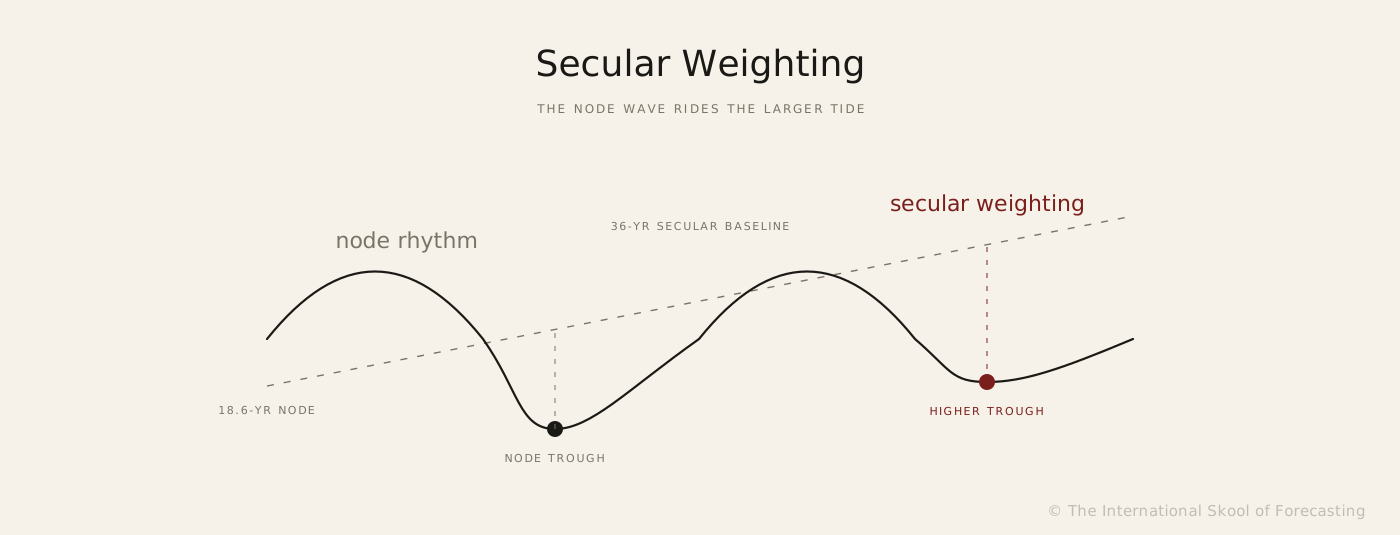 The node wave gives the timing frequency. The larger secular condition changes the amplitude and determines whether a low is dangerous, tradable, or muted.
Figure 1 illustrates this mechanic. The node wave dictates the frequency of the swings. The secular baseline dictates the amplitude. Retail traders who short the market purely on a Node Low ignore secular lift. They get trapped. Confluence between the lunar cycle and the secular trend dictates execution.
Degree Triggers and Anniversaries.
The seasonal bands give you the shape of the year. They will not give you a date. For that you need a fixed point to measure from.
That fixed point is the asset's own founding degree, and it turns a rough seasonal expectation into a date you can put in a diary.
The rule is this: you take the degree the node occupied at the asset's founding, and you watch for the node to return to it. That return date is the anchor, and it can be calculated years ahead.
You read that anchor against the long cycles and the secular weighting. Where the three agree, the timing window narrows from a season to a matter of weeks.
The major lows arrive as the node sweeps back across those same degrees. That is the practical use of the rule: you are watching a fixed date approach, not waiting for sentiment to turn.
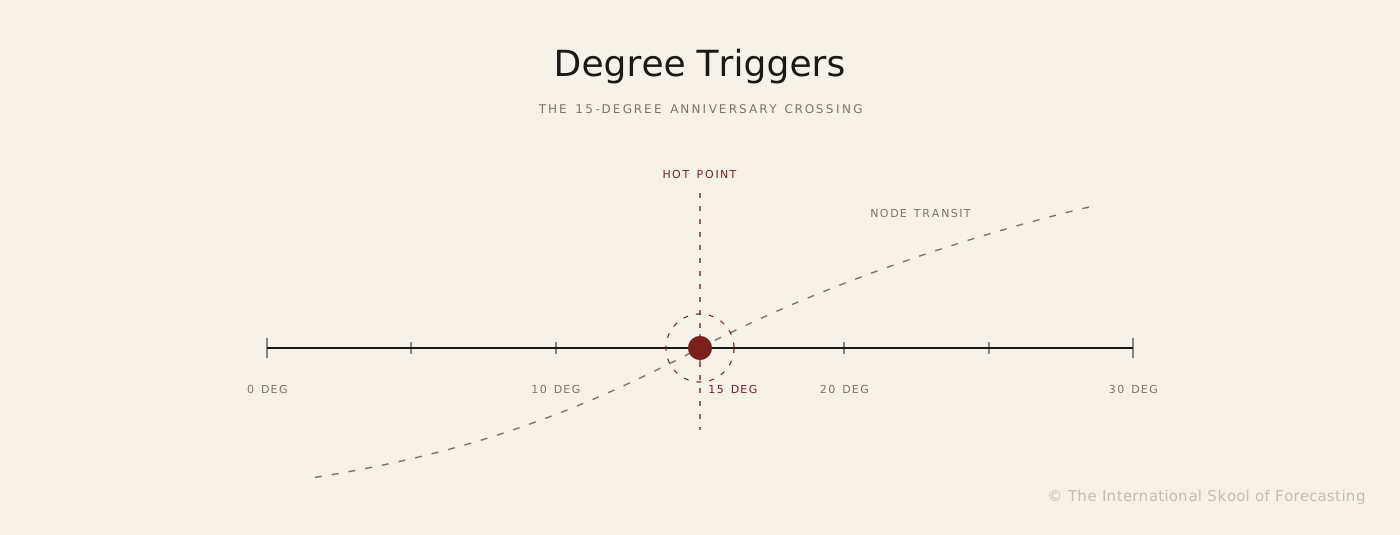 The public article can show the principle. The paid study teaches how to identify, test, and review the exact trigger coordinates without turning them into blind signals.
There is no ambiguity in this measurement. The node crosses the degree, or it does not. The market reacts, or it does not. The rule is objective.
Advanced Mechanics: Eclipses and Inversion.
A standard reading of McWhirter provides a formidable baseline. However, execution requires managing anomalies. Market crashes often defy baseline trends. They break standard support levels. The cause is rarely arbitrary. The cause is usually an eclipse or a retrograde inversion.
Solar and Lunar eclipses act as hard triggers. When an eclipse falls directly on a 15-degree hot spot, or directly aligns with an asset's baseline DNA, the standard energetic impact multiplies. An eclipse operates as a massive volume accelerant.
More critically, forecasters must master the rule of Retrograde Inversion. Planetary aspects are not static. When a planet enters retrograde motion—appearing to move backward from Earth's perspective—its energetic polarity flips. Positive aspects become severe resistance points. Negative aspects invert into massive buying opportunities.
W.D. Gann famously executed trades against the public during the total solar eclipse of June 1927. He anticipated a massive rally from an otherwise devastating celestial alignment. Why? Because Saturn was retrograde. The negative aspect inverted. Retail traders shorted the alignment. Gann bought the inversion. He pyramided his position. He captured the entire move.
The three timing scales.
The International Skool of Forecasting treats the McWhirter framework as an operational system. It consists of three distinct layers. Forecasters must identify their active timeframe before allocating capital.
- The Generational Scale: The 18.6-year node cycle weighted against the 36-year secular wave. This scale determines macro expansion or contraction. It frames the primary direction of the investment portfolio. (The 18.6-year cycle is precisely half of the master 37-year cycle).
- The Monthly Scale: The rapid 27.3-day transit of the Moon through the signs. McWhirter used this faster rhythm to identify short-term swings and sudden shifts in retail sentiment. It identifies tactical entries and exits within the primary trend.
- The Personal Scale: The individual forecaster's baseline. This scale measures planetary transits against the forecaster's own natal chart. It defines personal risk capacity and identifies when to increase leverage or preserve capital based on individual structural vulnerability.
Execution requires synthesizing all three timing scales. Identify the secular weight. Calculate the precise anniversary degree triggers. Track the primary significators. Monitor the eclipses. Filter for retrograde inversions.
Execution Over Theory.
Public summaries of the 18.6-year cycle offer theory. They provide context. Context is not an edge. An edge requires mechanical rules.
Knowing that the Node is in Aquarius is useless without knowing the secular weight. Anticipating a turning point in June is useless without identifying the exact 60-minute degree crossing that triggers the order. Fearing a negative Saturn transit is useless without verifying if Saturn is retrograde, which inverts the signal into a buying opportunity.
Advanced forecasters go further and read price itself as degrees. If the Moon sits at 192 degrees of longitude, a stock trading at $192 is sitting on the same number, and that is where the resistance shows up.
The complete mathematical methodology is not public. It is available inside our curriculum. The curriculum details how to build the baseline charts, how to calculate the price-to-degree conversions, how to track the eclipses, and how to apply McWhirter's exact proprietary rules to modern equities and cryptocurrency markets.
The full video study is available here: The McWhirter Method.
This essay gives the public framework: the node rhythm, secular weighting, and degree-trigger logic. The course teaches how the monthly reading is built, how the rules are applied to market charts, how inversions are reviewed, and how lunar pressure fits inside the larger forecasting framework. If you want the full rulebook, continue into The McWhirter Method. If you want the broader historical field first, continue into The 36-Year Cycle: Saturn in Aries.
Explore The McWhirter Method